


Page 248 - Euclid's Elements of Geometry
P. 248
ST	EW      hþ.


                                                                                            ELEMENTS BOOK 8


            Ε πλευραὶ οἱ Θ, Κ, τοῦ δὲ Η οἱ Λ, Μ. φανερὸν ἄρα ἐστὶν thus similar plane numbers [Prop. 8.20]. Therefore, let
            ἐκ τοῦ πρὸ τούτου, ὅτι οἱ Ε, Ζ, Η ἑξῆς εἰσιν ἀνάλογον ἔν H, K be the sides of E, and L, M (the sides) of G. Thus,
            τε τῷ τοῦ Θ πρὸς τὸν Λ λόγῳ καὶ τῷ τοῦ Κ πρὸς τὸν Μ. it is clear from the (proposition) before this (one) that E,
            καὶ ἐπεὶ οἱ Ε, Ζ, Η ἐλάχιστοί εἰσι τῶν τὸν αὐτὸν λόγον F, G are continuously proportional in the ratio of H to
            ἐχόντων τοῖς Α, Γ, Δ, καί ἐστιν ἴσον τὸ πλῆθος τῶν Ε,  L, and of K to M. And since E, F, G are the least (num-
            Ζ, Η τῷ πλήθει τῶν Α, Γ, Δ, δι᾿ ἴσου ἄρα ἐστὶν ὡς ὁ Ε  bers) having the same ratio as A, C, D, and the multitude
            πρὸς τὸν Η, οὕτως ὁ Α πρὸς τὸν Δ. οἱ δὲ Ε, Η πρῶτοι, οἱ  of E, F, G is equal to the multitude of A, C, D, thus,
            δὲ πρῶτοι καὶ ἐλάχιστοι, οἱ δὲ ἐλάχιστοι μετροῦσι τοὺς τὸν via equality, as E is to G, so A (is) to D [Prop. 7.14].
            αὐτὸν λόγον ἔχοντας αὐτοῖς ἰσάκις ὅ τε μείζων τὸν μείζονα And E and G (are) prime (to one another), and prime
            καὶ ὁ ἐλάσσων τὸν ἐλάσσονα, τουτέστιν ὅ τε ἡγούμενος (numbers) are also the least (of those numbers having
            τὸν ἡγούμενον καὶ ὁ ἑπόμενος τὸν ἑπόμενον· ἰσάκις ἄρα the same ratio as them) [Prop. 7.21], and the least (num-
            ὁ Ε τὸν Α μετρεῖ καὶ ὁ Η τὸν Δ. ὁσάκις δὴ ὁ Ε τὸν Α bers) measure those (numbers) having the same ratio as
            μετρεῖ, τοσαῦται μονάδες ἔστωσαν ἐν τῷ Ν. ὁ Ν ἄρα τὸν Ε  them an equal number of times, the greater (measuring)
            πολλαπλασιάσας τὸν Α πεποίηκεν. ὁ δὲ Ε ἐστιν ὁ ἐκ τῶν  the greater, and the lesser the lesser—that is to say, the
            Θ, Κ· ὁ Ν ἄρα τὸν ἐκ τῶν Θ, Κ πολλαπλασιάσας τὸν Α leading (measuring) the leading, and the following the
            πεποίηκεν. στερεὸς ἄρα ἐστὶν ὁ Α, πλευραὶ δὲ αὐτοῦ εἰσιν following [Prop. 7.20]. Thus, E measures A the same
            οἱ Θ, Κ, Ν. πάλιν, ἐπεὶ οἱ Ε, Ζ, Η ἐλάχιστοί εἰσι τῶν τὸν number of times as G (measures) D. So as many times as
            αὐτὸν λόγον ἐχόντων τοῖς Γ, Δ, Β, ἰσάκις ἄρα ὁ Ε τὸν Γ  E measures A, so many units let there be in N. Thus, N
            μετρεῖ καὶ ὁ Η τὸν Β. ὁσάκις δὴ ὁ Ε τὸν Γ μετρεῖ, τοσαῦται has made A (by) multiplying E [Def. 7.15]. And E is the
            μονάδες ἔστωσαν ἐν τῷ Ξ. ὁ Η ἄρα τὸν Β μετρεῖ κατὰ τὰς (number created) from (multiplying) H and K. Thus, N
            ἐν τῷ Ξ μονάδας· ὁ Ξ ἄρα τὸν Η πολλαπλασιάσας τὸν Β  has made A (by) multiplying the (number created) from
            πεποίηκεν. ὁ δὲ Η ἐστιν ὁ ἐκ τῶν Λ, Μ· ὁ Ξ ἄρα τὸν ἐκ  (multiplying) H and K. Thus, A is solid, and its sides are
            τῶν Λ, Μ πολλαπλασιάσας τὸν Β πεποίηκεν. στερεὸς ἄρα H, K, N. Again, since E, F, G are the least (numbers)
            ἐστὶν ὁ Β, πλευραὶ δὲ αὐτοῦ εἰσιν οἱ Λ, Μ, Ξ· οἱ Α, Β ἄρα having the same ratio as C, D, B, thus E measures C the
            στερεοί εἰσιν.                                      same number of times as G (measures) B [Prop. 7.20].
                                                                So as many times as E measures C, so many units let
                                                                there be in O. Thus, G measures B according to the units
                                                                in O. Thus, O has made B (by) multiplying G. And
                                                                G is the (number created) from (multiplying) L and M.
                                                                Thus, O has made B (by) multiplying the (number cre-
                                                                ated) from (multiplying) L and M. Thus, B is solid, and
                                                                its sides are L, M, O. Thus, A and B are (both) solid.
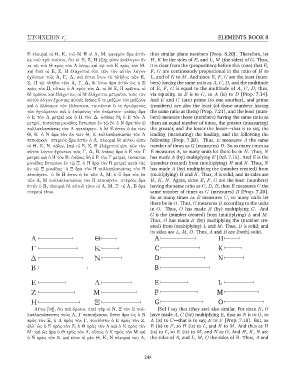
              Α                          Θ                        A                         H
              Γ                          Κ                        C                         K
              ∆                          Ν                        D                         N

              Β                                                   B


              Ε                          Λ                        E                         L

              Ζ                         Μ                         F                         M
              Η                          Ξ                        G                         O
               Λέγω [δή], ὅτι καὶ ὅμοιοι. ἐπεὶ γὰρ οἱ Ν, Ξ τὸν Ε πολ-  [So] I say that (they are) also similar. For since N, O
            λαπλασιάσαντες τοὺς Α, Γ πεποιήκασιν, ἔστιν ἄρα ὡς ὁ Ν have made A, C (by) multiplying E, thus as N is to O, so
            πρὸς τὸν Ξ, ὁ Α πρὸς τὸν Γ, τουτέστιν ὁ Ε πρὸς τὸν Ζ. A (is) to C—that is to say, E to F [Prop. 7.18]. But, as
            ἀλλ᾿ ὡς ὁ Ε πρὸς τὸν Ζ, ὁ Θ πρὸς τὸν Λ καὶ ὁ Κ πρὸς τὸν E (is) to F, so H (is) to L, and K to M. And thus as H
            Μ· καὶ ὡς ἄρα ὁ Θ πρὸς τὸν Λ, οὕτως ὁ Κ πρὸς τὸν Μ καὶ (is) to L, so K (is) to M, and N to O. And H, K, N are
            ὁ Ν πρὸς τὸν Ξ. καί εἰσιν οἱ μὲν Θ, Κ, Ν πλευραὶ τοῦ Α, the sides of A, and L, M, O the sides of B. Thus, A and


                                                             248

