


Page 25 - Euclid's Elements of Geometry
P. 25
ST	EW      aþ.


            ΓΕΒ μείζων ἐστὶ τῆς ὑπὸ ΒΑΓ. ἀλλὰ τῆς ὑπὸ ΓΕΒ μείζων (the sum of) BD and DC.    ELEMENTS BOOK 1
            ἐδείχθη ἡ ὑπὸ ΒΔΓ· πολλῷ ἄρα ἡ ὑπὸ ΒΔΓ μείζων ἐστὶ     Again, since in any triangle the external angle is
            τῆς ὑπὸ ΒΑΓ.                                        greater than the internal and opposite (angles) [Prop.
               ᾿Εὰν ἄρα τριγώνου ἐπὶ μιᾶς τῶν πλευρῶν ἀπὸ τῶν   1.16], in triangle CDE the external angle BDC is thus
            περάτων δύο εὐθεῖαι ἐντὸς συσταθῶσιν, αἱ συσταθεῖσαι τῶν  greater than CED. Accordingly, for the same (reason),
                                   kbþ                          one of the sides of a triangle, from its ends, the con-
            λοιπῶν τοῦ τριγώνου δύο πλευρῶν ἐλάττονες μέν εἰσιν, the external angle CEB of the triangle ABE is also
            μείζονα δὲ γωνίαν περιέχουσιν· ὅπερ ἔδει δεῖξαι.    greater than BAC. But, BDC was shown (to be) greater
                                                                than CEB. Thus, BDC is much greater than BAC.
                                                                   Thus, if two internal straight-lines are constructed on
                                                                structed (straight-lines) are less than the two remain-
                                                                ing sides of the triangle, but encompass a greater angle.
                                                                (Which is) the very thing it was required to show.
                                      .
                                                                                 Proposition 22
               ᾿Εκ τριῶν εὐθειῶν, αἵ εἰσιν ἴσαι τρισὶ ταῖς δοθείσαις  To construct a triangle from three straight-lines which
            [εὐθείαις], τρίγωνον συστήσασθαι· δεῖ δὲ τὰς δύο τῆς λοιπῆς are equal to three given [straight-lines]. It is necessary
            μείζονας εἶναι πάντῃ μεταλαμβανομένας [διὰ τὸ καὶ παντὸς for (the sum of) two (of the straight-lines) taken together
            τριγώνου τὰς δύο πλευρὰς τῆς λοιπῆς μείζονας εἶναι πάντῃ in any (possible way) to be greater than the remaining
            μεταλαμβανομένας].                                  (one), [on account of the (fact that) in any triangle (the
                                                                sum of) two sides taken together in any (possible way) is
                                                                greater than the remaining (one) [Prop. 1.20] ].
             Α                                                   A
             Β                                                   B
             Γ                                                   C

                                               Κ                                                  K


                    ∆                                       Ε          D                                       E
                                   Ζ          Η        Θ                              F           G       H


                                               Λ                                                  L


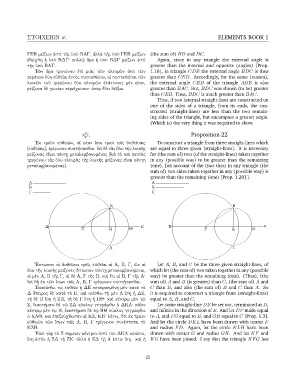
               ῎Εστωσαν αἱ δοθεῖσαι τρεῖς εὐθεῖαι αἱ Α, Β, Γ, ὧν αἱ  Let A, B, and C be the three given straight-lines, of
            δύο τῆς λοιπῆς μείζονες ἔστωσαν πάντῃ μεταλαμβανόμεναι, which let (the sum of) two taken together in any (possible
            αἱ μὲν Α, Β τῆς Γ, αἱ δὲ Α, Γ τῆς Β, καὶ ἔτι αἱ Β, Γ τῆς Α· way) be greater than the remaining (one). (Thus), (the
            δεῖ δὴ ἐκ τῶν ἴσων ταῖς Α, Β, Γ τρίγωνον συστήσασθαι.  sum of) A and B (is greater) than C, (the sum of) A and
               ᾿Εκκείσθω τις εὐθεῖα ἡ ΔΕ πεπερασμένη μὲν κατὰ τὸ  C than B, and also (the sum of) B and C than A. So
            Δ ἄπειρος δὲ κατὰ τὸ Ε, καὶ κείσθω τῇ μὲν Α ἴση ἡ ΔΖ, it is required to construct a triangle from (straight-lines)
            τῇ δὲ Β ἴση ἡ ΖΗ, τῇ δὲ Γ ἴση ἡ ΗΘ· καὶ κέντρῳ μὲν τῷ equal to A, B, and C.
            Ζ, διαστήματι δὲ τῷ ΖΔ κύκλος γεγράφθω ὁ ΔΚΛ· πάλιν    Let some straight-line DE be set out, terminated at D,
            κέντρῳ μὲν τῷ Η, διαστήματι δὲ τῷ ΗΘ κύκλος γεγράφθω  and infinite in the direction of E. And let DF made equal
            ὁ ΚΛΘ, καὶ ἐπεζεύχθωσαν αἱ ΚΖ, ΚΗ· λέγω, ὅτι ἐκ τριῶν  to A, and FG equal to B, and GH equal to C [Prop. 1.3].
            εὐθειῶν τῶν ἴσων ταῖς Α, Β, Γ τρίγωνον συνέσταται τὸ  And let the circle DKL have been drawn with center F
            ΚΖΗ.                                                and radius FD. Again, let the circle KLH have been
               ᾿Επεὶ γὰρ τὸ Ζ σημεῖον κέντρον ἐστὶ τοῦ ΔΚΛ κύκλου, drawn with center G and radius GH. And let KF and
            ἴση ἐστὶν ἡ ΖΔ τῇ ΖΚ· ἀλλὰ ἡ ΖΔ τῇ Α ἐστιν ἴση. καὶ ἡ  KG have been joined. I say that the triangle KFG has


                                                              25

