


Page 26 - Euclid's Elements of Geometry
P. 26
ST	EW      aþ.


                                                                                            ELEMENTS BOOK 1


            ΚΖ ἄρα τῇ Α ἐστιν ἴση. πάλιν, ἐπεὶ τὸ Η σημεῖον κέντρον been constructed from three straight-lines equal to A, B,
            ἐστὶ τοῦ ΛΚΘ κύκλου, ἴση ἐστὶν ἡ ΗΘ τῇ ΗΚ· ἀλλὰ ἡ ΗΘ  and C.
            τῇ Γ ἐστιν ἴση· καὶ ἡ ΚΗ ἄρα τῇ Γ ἐστιν ἴση. ἐστὶ δὲ καὶ ἡ  For since point F is the center of the circle DKL, FD
            ΖΗ τῇ Β ἴση· αἱ τρεῖς ἄρα εὐθεῖαι αἱ ΚΖ, ΖΗ, ΗΚ τρισὶ ταῖς is equal to FK. But, FD is equal to A. Thus, KF is also
            Α, Β, Γ ἴσαι εἰσίν.                                 equal to A. Again, since point G is the center of the circle
               ᾿Εκ τριῶν ἄρα εὐθειῶν τῶν ΚΖ, ΖΗ, ΗΚ, αἵ εἰσιν LKH, GH is equal to GK. But, GH is equal to C. Thus,
                                   kgþ                          the three straight-lines KF, FG, and GK, which are
            ἴσαι τρισὶ ταῖς δοθείσαις εὐθείαις ταῖς Α, Β, Γ, τρίγωνον  KG is also equal to C. And FG is also equal to B. Thus,
            συνέσταται τὸ ΚΖΗ· ὅπερ ἔδει ποιῆσαι.               the three straight-lines KF, FG, and GK are equal to A,
                                                                B, and C (respectively).
                                                                   Thus, the triangle KFG has been constructed from

                                                                equal to the three given straight-lines A, B, and C (re-
                                                                spectively). (Which is) the very thing it was required to
                                                                do.

                                                                                 Proposition 23
                                      .
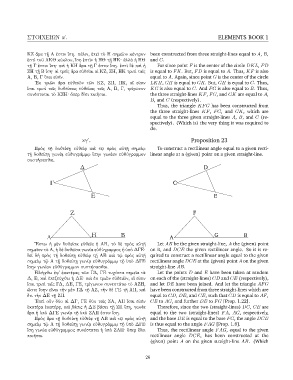
               Πρὸς τῇ δοθείσῃ εὐθείᾳ καὶ τῷ πρὸς αὐτῇ σημείῳ      To construct a rectilinear angle equal to a given recti-
            τῇ δοθείσῃ γωνίᾳ εὐθυγράμμῳ ἴσην γωνίαν εὐθύγραμμον linear angle at a (given) point on a given straight-line.
            συστήσασθαι.
                                   ∆                                                  D


                      Γ                                                  C

                                       Ε                                                  E


                              Ζ                                                   F


                                       Η            Β                                      G           B
                     Α                                                  A
               ῎Εστω ἡ μὲν δοθεῖσα εὐθεῖα ἡ ΑΒ, τὸ δὲ πρὸς αὐτῇ    Let AB be the given straight-line, A the (given) point
            σημεῖον τὸ Α, ἡ δὲ δοθεῖσα γωνία εὐθύγραμμος ἡ ὑπὸ ΔΓΕ·  on it, and DCE the given rectilinear angle. So it is re-
            δεῖ δὴ πρὸς τῇ δοθείσῃ εὐθείᾳ τῇ ΑΒ καὶ τῷ πρὸς αὐτῇ quired to construct a rectilinear angle equal to the given
            σημείῳ τῷ Α τῇ δοθείσῃ γωνίᾳ εὐθυγράμμῳ τῇ ὑπὸ ΔΓΕ  rectilinear angle DCE at the (given) point A on the given
            ἴσην γωνίαν εὐθύγραμμον συστήσασθαι.                straight-line AB.
               Εἰλήφθω ἐφ᾿ ἑκατέρας τῶν ΓΔ, ΓΕ τυχόντα σημεῖα τὰ   Let the points D and E have been taken at random
            Δ, Ε, καὶ ἐπεζεύχθω ἡ ΔΕ· καὶ ἐκ τριῶν εὐθειῶν, αἵ εἰσιν on each of the (straight-lines) CD and CE (respectively),
            ἴσαι τρισὶ ταῖς ΓΔ, ΔΕ, ΓΕ, τρίγωνον συνεστάτω τὸ ΑΖΗ, and let DE have been joined. And let the triangle AFG
            ὥστε ἴσην εἶναι τὴν μὲν ΓΔ τῇ ΑΖ, τὴν δὲ ΓΕ τῇ ΑΗ, καὶ have been constructed from three straight-lines which are
            ἔτι τὴν ΔΕ τῇ ΖΗ.                                   equal to CD, DE, and CE, such that CD is equal to AF,
               ᾿Επεὶ οὖν δύο αἱ ΔΓ, ΓΕ δύο ταῖς ΖΑ, ΑΗ ἴσαι εἰσὶν CE to AG, and further DE to FG [Prop. 1.22].
            ἑκατέρα ἑκατέρᾳ, καὶ βάσις ἡ ΔΕ βάσει τῇ ΖΗ ἴση, γωνία  Therefore, since the two (straight-lines) DC, CE are
            ἄρα ἡ ὑπὸ ΔΓΕ γωνίᾳ τῇ ὑπὸ ΖΑΗ ἐστιν ἴση.           equal to the two (straight-lines) FA, AG, respectively,
               Πρὸς ἄρα τῇ δοθείσῃ εὐθείᾳ τῇ ΑΒ καὶ τῷ πρὸς αὐτῇ and the base DE is equal to the base FG, the angle DCE
            σημείῳ τῷ Α τῇ δοθείσῃ γωνίᾳ εὐθυγράμμῳ τῇ ὑπὸ ΔΓΕ  is thus equal to the angle FAG [Prop. 1.8].
            ἴση γωνία εὐθύγραμμος συνέσταται ἡ ὑπὸ ΖΑΗ· ὅπερ ἔδει  Thus, the rectilinear angle FAG, equal to the given
            ποιῆσαι.                                            rectilinear angle DCE, has been constructed at the
                                                                (given) point A on the given straight-line AB. (Which


                                                              26

