


Page 250 - Euclid's Elements of Geometry
P. 250
ST	EW      hþ.


                                                                                            ELEMENTS BOOK 8


            ἐχέτωσαν, ὃν τετράγωνος ἀριθμὸς ὁ Γ πρὸς τετράγωνον the ratio which the square number C (has) to the square
            ἀριθμὸν τὸν Δ, ὁ δὲ Α τετράγωνος ἔστω· λέγω, ὅτι καὶ ὁ  number D. And let A be square. I say that B is also
                                   keþ
            Β τετράγωνός ἐστιν.                                 square.
               ᾿Επεὶ γὰρ οἱ Γ, Δ τετράγωνοί εἰσιν, οἱ Γ, Δ ἄρα ὅμοιοι  For since C and D are square, C and D are thus sim-
            ἐπίπεδοί εἰσιν. τῶν Γ, Δ ἄρα εἷς μέσος ἀνάλογον ἐμπίπτει ilar plane (numbers). Thus, one number falls (between)
            ἀριθμός. καί ἐστιν ὡς ὁ Γ πρὸς τὸν Δ, ὁ Α πρὸς τὸν Β· C and D in mean proportion [Prop. 8.18]. And as C is
            καὶ τῶν Α, Β ἄρα εἷς μέσος ἀνάλογον ἐμπίπτει ἀριθμός. καί to D, (so) A (is) to B. Thus, one number also falls (be-
            ἐστιν ὁ Α τετράγωνος· καὶ ὁ Β ἄρα τετράγωνός ἐστιν· ὅπερ tween) A and B in mean proportion [Prop. 8.8]. And A
            ἔδει δεῖξαι.                                        is square. Thus, B is also square [Prop. 8.22]. (Which is)
                                                                the very thing it was required to show.

                                      .
                                                                                 Proposition 25
               ᾿Εὰν δύο ἀριθμοὶ πρὸς ἀλλήλους λόγον ἔχωσιν, ὃν     If two numbers have to one another the ratio which
            κύβος ἀριθμὸς πρὸς κύβον ἀριθμόν, ὁ δὲ πρῶτος κύβος ᾖ, a cube number (has) to a(nother) cube number, and the
            καὶ ὁ δεύτερος κύβος ἔσται.                         first is cube, then the second will also be cube.
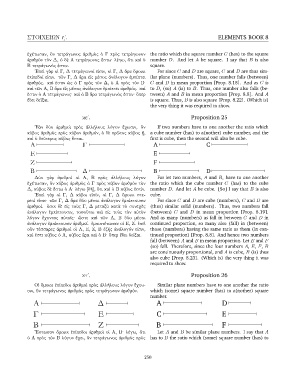
              Α                     Γ                            A                     C
              Ε                                                  E

              Ζ                                                  F
              Β                     ∆                            B                     D
               Δύο γὰρ ἀριθμοὶ οἱ Α, Β πρὸς ἀλλήλους λόγον         For let two numbers, A and B, have to one another
            ἐχέτωσαν, ὃν κύβος ἀριθμὸς ὁ Γ πρὸς κύβον ἀριθμὸν τὸν the ratio which the cube number C (has) to the cube
            Δ, κύβος δὲ ἔστω ὁ Α· λέγω [δή], ὅτι καὶ ὁ Β κύβος ἐστίν. number D. And let A be cube. [So] I say that B is also
               ᾿Επεὶ γὰρ οἱ Γ, Δ κύβοι εἰσίν, οἱ Γ, Δ ὅμοιοι στε-  cube.
            ρεοί εἰσιν· τῶν Γ, Δ ἄρα δύο μέσοι ἀνάλογον ἐμπίπτουσιν  For since C and D are cube (numbers), C and D are
            ἀριθμοί. ὅσοι δὲ εἰς τοὺς Γ, Δ μεταξὺ κατὰ τὸ συνεχὲς (thus) similar solid (numbers). Thus, two numbers fall
            ἀνάλογον ἐμπίπτουσιν, τοσοῦτοι καὶ εἰς τοὺς τὸν αὐτὸν (between) C and D in mean proportion [Prop. 8.19].
            λόγον ἔχοντας αὐτοῖς· ὥστε καὶ τῶν Α, Β δύο μέσοι   And as many (numbers) as fall in between C and D in
                                   kþ                          (so) fall. Therefore, since the four numbers A, E, F, B
            ἀνάλογον ἐμπίπτουσιν ἀριθμοί. ἐμπιπτέτωσαν οἱ Ε, Ζ. ἐπεὶ continued proportion, so many also (fall) in (between)
            οὖν τέσσαρες ἀριθμοὶ οἱ Α, Ε, Ζ, Β ἑξῆς ἀνάλογόν εἰσιν, those (numbers) having the same ratio as them (in con-
            καί ἐστι κύβος ὁ Α, κύβος ἄρα καὶ ὁ Β· ὅπερ ἔδει δεῖξαι.  tinued proportion) [Prop. 8.8]. And hence two numbers
                                                                fall (between) A and B in mean proportion. Let E and F

                                                                are continuously proportional, and A is cube, B (is) thus
                                                                also cube [Prop. 8.23]. (Which is) the very thing it was
                                                                required to show.

                                      .
                                                                                 Proposition 26
               Οἱ ὅμοιοι ἐπίπεδοι ἀριθμοὶ πρὸς ἀλλήλους λόγον ἔχου-  Similar plane numbers have to one another the ratio
            σιν, ὃν τετράγωνος ἀριθμὸς πρὸς τετράγωνον ἀριθμόν.  which (some) square number (has) to a(nother) square
                                                                number.
               Α                          ∆                       A                           D

               Γ                          Ε                       C                           E

               Β                          Ζ                       B                           F
               ῎Εστωσαν ὅμοιοι ἐπίπεδοι ἀριθμοὶ οἱ Α, Β· λέγω, ὅτι  Let A and B be similar plane numbers. I say that A
            ὁ Α πρὸς τὸν Β λόγον ἔχει, ὃν τετράγωνος ἀριθμὸς πρὸς  has to B the ratio which (some) square number (has) to


                                                             250

