


Page 251 - Euclid's Elements of Geometry
P. 251
ST	EW      hþ.


            τετράγωνον ἀριθμόν.                                 a(nother) square number.    ELEMENTS BOOK 8
               ᾿Επεὶ γὰρ οἱ Α, Β ὅμοιοι ἐπίπεδοί εἰσιν, τῶν Α, Β ἄρα  For since A and B are similar plane numbers, one
            εἷς μέσος ἀνάλογον ἐμπίπτει ἀριθμός. ἐμπιπτέτω καὶ ἔστω ὁ  number thus falls (between) A and B in mean propor-
                                   kzþ
            Γ, καὶ εἰλήφθωσαν ἐλάχιστοι ἀριθμοὶ τῶν τὸν αὐτὸν λόγον tion [Prop. 8.18]. Let it (so) fall, and let it be C. And
            ἐχόντων τοῖς Α, Γ, Β οἱ Δ, Ε, Ζ· οἱ ἄρα ἄκροι αὐτῶν οἱ  let the least numbers, D, E, F, having the same ratio
            Δ, Ζ τετράγωνοί εἰσιν. καὶ ἐπεί ἐστιν ὡς ὁ Δ πρὸς τὸν Ζ, as A, C, B have been taken [Prop. 8.2]. The outermost
            οὕτως ὁ Α πρὸς τὸν Β, καί εἰσιν οἱ Δ, Ζ τετράγωνοι, ὁ Α of them, D and F, are thus square [Prop. 8.2 corr.]. And
            ἄρα πρὸς τὸν Β λόγον ἔχει, ὃν τετράγωνος ἀριθμὸς πρὸς  since as D is to F, so A (is) to B, and D and F are square,
            τετράγωνον ἀριθμόν· ὅπερ ἔδει δεῖξαι.               A thus has to B the ratio which (some) square number
                                                                (has) to a(nother) square number. (Which is) the very
                                                                thing it was required to show.


                                                                                 Proposition 27
                                      .
               Οἱ ὅμοιοι στερεοὶ ἀριθμοὶ πρὸς ἀλλήλους λόγον ἔχου-  Similar solid numbers have to one another the ratio
            σιν, ὃν κύβος ἀριθμὸς πρὸς κύβον ἀριθμόν.           which (some) cube number (has) to a(nother) cube num-
                                                                ber.
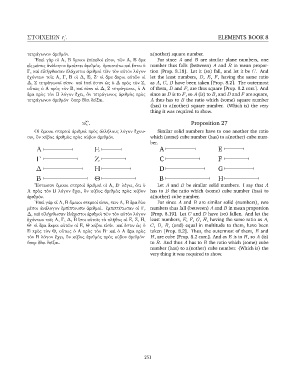
                Α                        Ε                          A                       E

                Γ                        Ζ                          C                       F
                ∆                        Η                          D                       G

                Β                        Θ                          B                       H
               ῎Εστωσαν ὅμοιοι στερεοὶ ἀριθμοὶ οἱ Α, Β· λέγω, ὅτι ὁ  Let A and B be similar solid numbers. I say that A
            Α πρὸς τὸν Β λόγον ἔχει, ὃν κύβος ἀριθμὸς πρὸς κύβον has to B the ratio which (some) cube number (has) to
            ἀριθμόν.                                            a(nother) cube number.
               ᾿Επεὶ γὰρ οἱ Α, Β ὅμοιοι στερεοί εἰσιν, τῶν Α, Β ἄρα δύο  For since A and B are similar solid (numbers), two
            μέσοι ἀνάλογον ἐμπίπτουσιν ἀριθμοί. ἐμπιπτέτωσαν οἱ Γ, numbers thus fall (between) A and B in mean proportion
            Δ, καὶ εἰλήφθωσαν ἐλάχιστοι ἀριθμοὶ τῶν τὸν αὐτὸν λόγον [Prop. 8.19]. Let C and D have (so) fallen. And let the
            ἐχόντων τοῖς Α, Γ, Δ, Β ἴσοι αὐτοῖς τὸ πλῆθος οἱ Ε, Ζ, Η, least numbers, E, F, G, H, having the same ratio as A,
            Θ· οἱ ἄρα ἄκροι αὐτῶν οἱ Ε, Θ κύβοι εἰσίν. καί ἐστιν ὡς ὁ  C, D, B, (and) equal in multitude to them, have been
            Ε πρὸς τὸν Θ, οὕτως ὁ Α πρὸς τὸν Β· καὶ ὁ Α ἄρα πρὸς  taken [Prop. 8.2]. Thus, the outermost of them, E and
            τὸν Β λόγον ἔχει, ὃν κύβος ἀριθμὸς πρὸς κύβον ἀριθμόν· H, are cube [Prop. 8.2 corr.]. And as E is to H, so A (is)
            ὅπερ ἔδει δεῖξαι.                                   to B. And thus A has to B the ratio which (some) cube
                                                                number (has) to a(nother) cube number. (Which is) the
                                                                very thing it was required to show.


                                                             251

