


Page 259 - Euclid's Elements of Geometry
P. 259
ST	EW      jþ.


                                                                                            ELEMENTS BOOK 9


            καὶ ὁ Ζ ἄρα κύβος ἐστίν. ἐδείχθη δὲ καὶ τετράγωνος· ὁ ἄρα number A according to the units in A. And thus B mea-
            ἕβδομος ἀπὸ τῆς μονάδος κύβος τέ ἐστι καὶ τετράγωνος. sures C according to the units in A. A has thus made C
            ὁμοίως δὴ δείξομεν, ὅτι καὶ οἱ πέντε διαλείποντες πάντες (by) multiplying B. Therefore, since A has made B (by)
            κύβοι τέ εἰσι καὶ τετράγωνοι· ὅπερ ἔδει δεῖξαι.     multiplying itself, and has made C (by) multiplying B, C
                                    jþ                          And it was also shown (to be) square. Thus, the seventh
                                                                is thus cube. And since C, D, E, F are continuously pro-
                                                                portional, and C is cube, F is thus also cube [Prop. 8.23].

                                                                (number) from the unit is (both) cube and square. So,
                                                                similarly, we can show that all those (numbers after that)
                                                                which leave an interval of five (numbers) are (both) cube
                                                                and square. (Which is) the very thing it was required to
                                                                show.

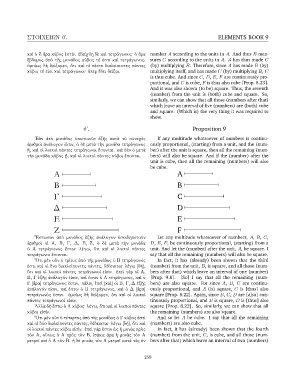
                                                                                  Proposition 9
                                      .
               ᾿Εὰν ἀπὸ μονάδος ὁποσοιοῦν ἑξῆς κατὰ τὸ συνεχὲς     If any multitude whatsoever of numbers is continu-
            ἀριθμοὶ ἀνάλογον ὦσιν, ὁ δὲ μετὰ τὴν μονάδα τετράγωνος  ously proportional, (starting) from a unit, and the (num-
            ᾖ, καὶ οἱ λοιποὶ πάντες τετράγωνοι ἔσονται. καὶ ἐὰν ὁ μετὰ ber) after the unit is square, then all the remaining (num-
            τὴν μονάδα κύβος ᾖ, καὶ οἱ λοιποὶ πάντες κύβοι ἔσονται.  bers) will also be square. And if the (number) after the
                                                                unit is cube, then all the remaining (numbers) will also
                                                                be cube.
                        Α                                                  A

                        Β                                                  B
                        Γ                                                  C

                        ∆                                                  D

                        Ε                                                  E

                        Ζ                                                  F
               ῎Εστωσαν ἀπὸ μονάδος ἑξῆς ἀνάλογον ὁσοιδηποτοῦν     Let any multitude whatsoever of numbers, A, B, C,
            ἀριθμοὶ οἱ Α, Β, Γ, Δ, Ε, Ζ, ὁ δὲ μετὰ τὴν μονάδα   D, E, F, be continuously proportional, (starting) from a
            ὁ Α τετράγωνος ἔστω· λέγω, ὅτι καὶ οἱ λοιποὶ πάντες unit. And let the (number) after the unit, A, be square. I
            τετράγωνοι ἔσονται.                                 say that all the remaining (numbers) will also be square.
               ῞Οτι μὲν οὖν ὁ τρίτος ἀπὸ τῆς μονάδος ὁ Β τετράγωνός  In fact, it has (already) been shown that the third
            ἐστι καὶ οἱ ἕνα διαπλείποντες πάντες, δέδεικται· λέγω [δή], (number) from the unit, B, is square, and all those (num-
            ὅτι καὶ οἱ λοιποὶ πάντες τετράγωνοί εἰσιν. ἐπεὶ γὰρ οἱ Α, bers after that) which leave an interval of one (number)
            Β, Γ ἑξῆς ἀνάλογόν εἰσιν, καί ἐστιν ὁ Α τετράγωνος, καὶ ὁ  [Prop. 9.8]. [So] I say that all the remaining (num-
            Γ [ἄρα] τετράγωνος ἐστιν. πάλιν, ἐπεὶ [καὶ] οἱ Β, Γ, Δ ἑξῆς bers) are also square. For since A, B, C are continu-
            ἀνάλογόν εἰσιν, καί ἐστιν ὁ Β τετράγωνος, καὶ ὁ Δ [ἄρα] ously proportional, and A (is) square, C is [thus] also
            τετράγωνός ἐστιν. ὁμοίως δὴ δείξομεν, ὅτι καὶ οἱ λοιποὶ square [Prop. 8.22]. Again, since B, C, D are [also] con-
            πάντες τετράγωνοί εἰσιν.                            tinuously proportional, and B is square, D is [thus] also
               ᾿Αλλὰ δὴ ἔστω ὁ Α κύβος· λέγω, ὅτι καὶ οἱ λοιποὶ πάντες square [Prop. 8.22]. So, similarly, we can show that all
            κύβοι εἰσίν.                                        the remaining (numbers) are also square.
               ῞Οτι μὲν οὖν ὁ τέταρτος ἀπὸ τῆς μονάδος ὁ Γ κύβος ἐστὶ  And so let A be cube. I say that all the remaining
            καὶ οἱ δύο διαλείποντες πάντες, δέδεικται· λέγω [δή], ὅτι καὶ (numbers) are also cube.
            οἱ λοιποὶ πάντες κύβοι εἰσίν. ἐπεὶ γάρ ἐστιν ὡς ἡ μονὰς πρὸς  In fact, it has (already) been shown that the fourth
            τὸν Α, οὕτως ὁ Α πρὸς τὸν Β, ἰσάκις ἀρα ἡ μονὰς τὸν Α (number) from the unit, C, is cube, and all those (num-
            μετρεῖ καὶ ὁ Α τὸν Β. ἡ δὲ μονὰς τὸν Α μετρεῖ κατὰ τὰς ἐν bers after that) which leave an interval of two (numbers)


                                                             259

