


Page 262 - Euclid's Elements of Geometry
P. 262
ST	EW      jþ.


                                                                                            ELEMENTS BOOK 9
                                 ìri  sma


            αὐτῷ μονάδας· καὶ ὁ Β ἄρα τὸν Ε μετρεῖ κατὰ τὰς ἐν τῷ measures D the same number of times as B (measures)
            Δ μονάδας· ὥστε ὁ ἐλάσσων ὁ Β τὸν μείζονα τὸν Ε με-  E [Prop. 7.15]. And the unit A measures D according to
            τρεῖ κατά τινα ἀριθμὸν τῶν ὑπαρχόντων ἐν τοῖς ἀνάλογον the units in it. Thus, B also measures E according to the
            ἀριθμοῖς.                                           units in D. Hence, the lesser (number) B measures the
                                                                greater E according to some existing number among the
                                                                proportional numbers (namely, D).
                                    ibþ                         place from the measured (number), in (the direction of
                                                                                    Corollary
                                         .
               Καὶ φανερόν, ὅτι ἣν ἔχει τάξιν ὁ μετρῶν ἀπὸ μονάδος,  And (it is) clear that what(ever relative) place the
            τὴν αὐτὴν ἔχει καὶ ὁ καθ᾿ ὃν μετρεῖ ἀπὸ τοῦ μετρουμένου measuring (number) has from the unit, the (number)
            ἐπὶ τὸ πρὸ αὐτοῦ. ὅπερ ἔδει δεῖξαι.                 according to which it measures has the same (relative)

                                                                the number) before it. (Which is) the very thing it was
                                                                required to show.

                                      .
                                                                                 Proposition 12
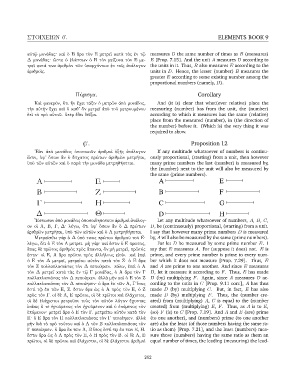
               ᾿Εὰν ἀπὸ μονάδος ὁποσοιοῦν ἀριθμοὶ ἑξῆς ἀνάλογον    If any multitude whatsoever of numbers is continu-
            ὦσιν, ὑφ᾿ ὅσων ἂν ὁ ἔσχατος πρώτων ἀριθμῶν μετρῆται, ously proportional, (starting) from a unit, then however
            ὑπὸ τῶν αὐτῶν καὶ ὁ παρὰ τὴν μονάδα μετρηθήσεται.   many prime numbers the last (number) is measured by,
                                                                the (number) next to the unit will also be measured by
                                                                the same (prime numbers).
                Α                        Ε                         A                         E

                Β                        Ζ                         B                         F

                Γ                        Η                         C                         G

                ∆                        Θ                         D                         H
               ῎Εστωσαν ἀπὸ μονάδος ὁποσοιδηποτοῦν ἀριθμοὶ ἀνάλογ-  Let any multitude whatsoever of numbers, A, B, C,
            ον οἱ Α, Β, Γ, Δ· λέγω, ὅτι ὑφ᾿ ὅσων ἂν ὁ Δ πρώτων D, be (continuously) proportional, (starting) from a unit.
            ἀριθμῶν μετρῆται, ὑπὸ τῶν αὐτῶν καὶ ὁ Α μετρηθήσεται.  I say that however many prime numbers D is measured
               Μετρείσθω γὰρ ὁ Δ ὑπό τινος πρώτου ἀριθμοῦ τοῦ Ε·  by, A will also be measured by the same (prime numbers).
            λέγω, ὅτι ὁ Ε τὸν Α μετρεῖ. μὴ γάρ· καί ἐστιν ὁ Ε πρῶτος,  For let D be measured by some prime number E. I
            ἅπας δὲ πρῶτος ἀριθμὸς πρὸς ἅπαντα, ὃν μὴ μετρεῖ, πρῶτός  say that E measures A. For (suppose it does) not. E is
            ἐστιν· οἱ Ε, Α ἄρα πρῶτοι πρὸς ἀλλήλους εἰσίν. καὶ ἐπεὶ prime, and every prime number is prime to every num-
            ὁ Ε τὸν Δ μετρεῖ, μετρείτω αὐτὸν κατὰ τὸν Ζ· ὁ Ε ἄρα ber which it does not measure [Prop. 7.29]. Thus, E
            τὸν Ζ πολλαπλασιάσας τὸν Δ πεποίηκεν. πάλιν, ἐπεὶ ὁ Α and A are prime to one another. And since E measures
            τὸν Δ μετρεῖ κατὰ τὰς ἐν τῷ Γ μονάδας, ὁ Α ἄρα τὸν Γ  D, let it measure it according to F. Thus, E has made
            πολλαπλασιάσας τὸν Δ πεποίηκεν. ἀλλὰ μὴν καὶ ὁ Ε τὸν Ζ  D (by) multiplying F. Again, since A measures D ac-
            πολλαπλασιάσας τὸν Δ πεποίηκεν· ὁ ἄρα ἐκ τῶν Α, Γ ἴσος cording to the units in C [Prop. 9.11 corr.], A has thus
            ἐστὶ τῷ ἐκ τῶν Ε, Ζ. ἔστιν ἄρα ὡς ὁ Α πρὸς τὸν Ε, ὁ Ζ  made D (by) multiplying C. But, in fact, E has also
            πρὸς τὸν Γ. οἱ δὲ Α, Ε πρῶτοι, οἱ δὲ πρῶτοι καὶ ἐλάχιστοι, made D (by) multiplying F. Thus, the (number cre-
            οἱ δὲ ἐλάχιστοι μετροῦσι τοὺς τὸν αὐτὸν λόγον ἔχοντας ated) from (multiplying) A, C is equal to the (number
            ἰσάκις ὅ τε ἡγούμενος τὸν ἡγούμενον καὶ ὁ ἑπόμενος τὸν created) from (multiplying) E, F. Thus, as A is to E,
            ἑπόμενον· μετρεῖ ἄρα ὁ Ε τὸν Γ. μετρείτω αὐτὸν κατὰ τὸν (so) F (is) to C [Prop. 7.19]. And A and E (are) prime
            Η· ὁ Ε ἄρα τὸν Η πολλαπλασιάσας τὸν Γ πεποίηκεν. ἀλλὰ (to one another), and (numbers) prime (to one another
            μὴν διὰ τὸ πρὸ τούτου καὶ ὁ Α τὸν Β πολλαπλασιάσας τὸν are) also the least (of those numbers having the same ra-
            Γ πεποίηκεν. ὁ ἄρα ἐκ τῶν Α, Β ἴσος ἐστὶ τῷ ἐκ τῶν Ε, Η. tio as them) [Prop. 7.21], and the least (numbers) mea-
            ἔστιν ἄρα ὡς ὁ Α πρὸς τὸν Ε, ὁ Η πρὸς τὸν Β. οἱ δὲ Α, Ε  sure those (numbers) having the same ratio as them an
            πρῶτοι, οἱ δὲ πρῶτοι καὶ ἐλάχιστοι, οἱ δὲ ἐλάχιστοι ἀριθμοὶ equal number of times, the leading (measuring) the lead-


                                                             262

