


Page 261 - Euclid's Elements of Geometry
P. 261
ST	EW      jþ.


                                                                                            ELEMENTS BOOK 9


            τοῦ τρίτου ἀπὸ τῆς μονάδος καὶ τῶν ἕνα διαλειπόντων.  [Prop. 8.26]. And B is square. Thus, A is also square.
               ᾿Αλλὰ δὴ μὴ ἔστω ὁ Α κύβος. λέγω, ὅτι οὐδ᾿ ἄλλος The very opposite thing was assumed. C is thus not
            οὐδεὶς κύβος ἔσται χωρὶς τοῦ τετάρτου ἀπὸ τῆς μονάδος  square. So, similarly, we can show that no other (number
            καὶ τῶν δύο διαλειπόντων.                           is) square either, apart from the third from the unit, and
               Εἰ γὰρ δυνατόν, ἔστω ὁ Δ κύβος. ἔστι δὲ καὶ ὁ Γ κύβος· (all) those (numbers after that) which leave an interval
            τέταρτος γάρ ἐστιν ἀπὸ τῆς μονάδος. καί ἐστιν ὡς ὁ Γ πρὸς  of one (number).
            τὸν Δ, ὁ Β πρὸς τὸν Γ· καὶ ὁ Β ἄρα πρὸς τὸν Γ λόγον ἔχει,  And so let A not be cube. I say that no other (num-
            ὃν κύβος πρὸς κύβον. καί ἐστιν ὁ Γ κύβος· καὶ ὁ Β ἄρα ber) will be cube either, apart from the fourth from the
            κύβος ἐστίν. καὶ ἐπεί ἐστιν ὡς ἡ μονὰς πρὸς τὸν Α, ὁ Α πρὸς  unit, and (all) those (numbers after that) which leave an
            τὸν Β, ἡ δὲ μονὰς τὸν Α μετρεῖ κατὰ τὰς ἐν αὐτῷ μονάδας, interval of two (numbers).
            καὶ ὁ Α ἄρα τὸν Β μετρεῖ κατὰ τὰς ἐν αὑτῷ μονάδας· ὁ Α  For, if possible, let D be cube. And C is also cube
            ἄρα ἑαυτὸν πολλαπλασιάσας κύβον τὸν Β πεποίηκεν. ἐὰν [Prop. 9.8]. For it is the fourth (number) from the unit.
            δὲ ἀριθμὸς ἑαυτὸν πολλαπλασιάσας κύβον ποιῇ, καὶ αὐτὸς And as C is to D, (so) B (is) to C. And B thus has to
            κύβος ἔσται. κύβος ἄρα καὶ ὁ Α· ὅπερ οὐχ ὑπόκειται. οὐκ C the ratio which (some) cube (number has) to (some
            ἄρα ὁ Δ κύβος ἐστίν. ὁμοίως δὴ δείξομεν, ὅτι οὐδ᾿ ἄλλος other) cube (number). And C is cube. Thus, B is also
            οὐδεὶς κύβος ἐστὶ χωρὶς τοῦ τετάρτου ἀπὸ τῆς μονάδος καὶ cube [Props. 7.13, 8.25]. And since as the unit is to
            τῶν δύο διαλειπόντων· ὅπερ ἔδει δεῖξαι.             A, (so) A (is) to B, and the unit measures A accord-
                                                                ing to the units in it, A thus also measures B according
                                                                to the units in (A). Thus, A has made the cube (num-
                                    iaþ                         cube [Prop. 9.6]. Thus, A (is) also cube. The very oppo-
                                                                ber) B (by) multiplying itself. And if a number makes a
                                                                cube (number by) multiplying itself then it itself will be
                                                                site thing was assumed. Thus, D is not cube. So, simi-
                                                                larly, we can show that no other (number) is cube either,
                                                                apart from the fourth from the unit, and (all) those (num-
                                                                bers after that) which leave an interval of two (numbers).
                                                                (Which is) the very thing it was required to show.

                                      .
                                                                                 Proposition 11
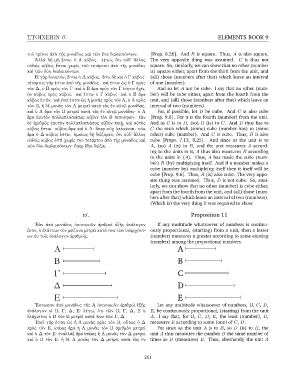
               ᾿Εὰν ἀπὸ μονάδος ὁποσοιοῦν ἀριθμοὶ ἑξῆς ἀνάλογον    If any multitude whatsoever of numbers is continu-
            ὦσιν, ὁ ἐλάττων τὸν μείζονα μετρεῖ κατά τινα τῶν ὑπαρχόντ- ously proportional, (starting) from a unit, then a lesser
            ων ἐν τοῖς ἀνάλογον ἀριθμοῖς.                       (number) measures a greater according to some existing
                                                                (number) among the proportional numbers.
                        Α                                                  A

                        Β                                                  B

                        Γ                                                  C


                        ∆                                                  D

                        Ε                                                  E
               ῎Εστωσαν ἀπὸ μονάδος τῆς Α ὁποσοιοῦν ἀριθμοὶ ἑξῆς   Let any multitude whatsoever of numbers, B, C, D,
            ἀνάλογον οἱ Β, Γ, Δ, Ε· λέγω, ὅτι τῶν Β, Γ, Δ, Ε ὁ  E, be continuously proportional, (starting) from the unit
            ἐλάχιστος ὁ Β τὸν Ε μετρεῖ κατά τινα τῶν Γ, Δ.      A. I say that, for B, C, D, E, the least (number), B,
               ᾿Επεὶ γάρ ἐστιν ὡς ἡ Α μονὰς πρὸς τὸν Β, οὕτως ὁ Δ measures E according to some (one) of C, D.
            πρὸς τὸν Ε, ἰσάκις ἄρα ἡ Α μονὰς τὸν Β ἀριθμὸν μετρεῖ  For since as the unit A is to B, so D (is) to E, the
            καὶ ὁ Δ τὸν Ε· ἐναλλὰξ ἄρα ἰσάκις ἡ Α μονὰς τὸν Δ μετρεῖ  unit A thus measures the number B the same number of
            καὶ ὁ Β τὸν Ε. ἡ δὲ Α μονὰς τὸν Δ μετρεῖ κατὰ τὰς ἐν times as D (measures) E. Thus, alternately, the unit A


                                                             261

