


Page 272 - Euclid's Elements of Geometry
P. 272
ST	EW      jþ.     kbþ                                                      ELEMENTS BOOK 9


                                                                                 Proposition 22
                                      .
               ᾿Εὰν περισσοὶ ἀριθμοὶ ὁποσοιοῦν συντεθῶσιν, τὸ δὲ  the very thing it was required to show.
                                                                   If any multitude whatsoever of odd numbers is added
            πλῆθος αὐτῶν ἄρτιον ᾖ, ὁ ὅλος ἄρτιος ἔσται.         together, and the multitude of them is even, then the
                                                                whole will be even.
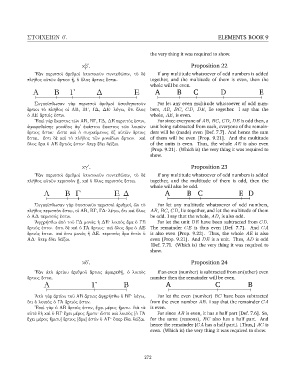
               Α        Β     Γ          ∆               Ε        A        B      C          D               E

               Συγκείσθωσαν γὰρ περισσοὶ ἀριθμοὶ ὁσοιδηποτοῦν      For let any even multitude whatsoever of odd num-
            ἄρτιοι τὸ πλῆθος οἱ ΑΒ, ΒΓ, ΓΔ, ΔΕ· λέγω, ὅτι ὅλος bers, AB, BC, CD, DE, lie together. I say that the
                                   kgþ
            ὁ ΑΕ ἄρτιός ἐστιν.                                  whole, AE, is even.
               ᾿Επεὶ γὰρ ἕκαστος τῶν ΑΒ, ΒΓ, ΓΔ, ΔΕ περιττός ἐστιν,  For since everyone of AB, BC, CD, DE is odd then, a
            ἀφαιρεθείσης μονάδος ἀφ᾿ ἑκάστου ἕκαστος τῶν λοιπῶν unit being subtracted from each, everyone of the remain-
            ἄρτιος ἔσται· ὥστε καὶ ὁ συγκείμενος ἐξ αὐτῶν ἄρτιος ders will be (made) even [Def. 7.7]. And hence the sum
            ἔσται. ἔστι δὲ καὶ τὸ πλῆθος τῶν μονάδων ἄρτιον. καὶ of them will be even [Prop. 9.21]. And the multitude
            ὅλος ἄρα ὁ ΑΕ ἄρτιός ἐστιν· ὅπερ ἔδει δεῖξαι.       of the units is even. Thus, the whole AE is also even
                                                                [Prop. 9.21]. (Which is) the very thing it was required to
                                                                show.

                                                                                 Proposition 23
                                      .
               ᾿Εὰν περισσοὶ ἀριθμοὶ ὁποσοιοῦν συντεθῶσιν, τὸ δὲ   If any multitude whatsoever of odd numbers is added
            πλῆθος αὐτῶν περισσὸν ᾖ, καὶ ὁ ὅλος περισσὸς ἔσται.  together, and the multitude of them is odd, then the
                                                                whole will also be odd.
                   Α        Β Γ                  Ε ∆                  A        B C                   E D

               Συγκείσθωσαν γὰρ ὁποσοιοῦν περισσοὶ ἀριθμοί, ὧν τὸ  For let any multitude whatsoever of odd numbers,
                                   kdþ
            πλῆθος περισσὸν ἔστω, οἱ ΑΒ, ΒΓ, ΓΔ· λέγω, ὅτι καὶ ὅλος AB, BC, CD, lie together, and let the multitude of them
            ὁ ΑΔ περισσός ἐστιν.                                be odd. I say that the whole, AD, is also odd.
               ᾿Αφῃρήσθω ἀπὸ τοῦ ΓΔ μονὰς ἡ ΔΕ· λοιπὸς ἄρα ὁ ΓΕ    For let the unit DE have been subtracted from CD.
            ἄρτιός ἐστιν. ἔστι δὲ καὶ ὁ ΓΑ ἄρτιος· καὶ ὅλος ἄρα ὁ ΑΕ  The remainder CE is thus even [Def. 7.7]. And CA
            ἄρτιός ἐστιν. καί ἐστι μονὰς ἡ ΔΕ. περισσὸς ἄρα ἐστὶν ὁ  is also even [Prop. 9.22]. Thus, the whole AE is also
            ΑΔ· ὅπερ ἔδει δεῖξαι.                               even [Prop. 9.21]. And DE is a unit. Thus, AD is odd
                                                                [Def. 7.7]. (Which is) the very thing it was required to
                                                                show.

                                                                                 Proposition 24
                                      .
               ᾿Εὰν ἀπὸ ἀρτίου ἀριθμοῦ ἄρτιος ἀφαιρεθῇ, ὁ λοιπὸς   If an even (number) is subtracted from an(other) even
            ἄρτιος ἔσται.                                       number then the remainder will be even.
                   Α                   Γ             Β                A                    C             B


               ᾿Απὸ γὰρ ἀρτίου τοῦ ΑΒ ἄρτιος ἀφῃρήσθω ὁ ΒΓ· λέγω,  For let the even (number) BC have been subtracted
            ὅτι ὁ λοιπὸς ὁ ΓΑ ἄρτιός ἐστιν.                     from the even number AB. I say that the remainder CA
               ᾿Επεὶ γὰρ ὁ ΑΒ ἄρτιός ἐστιν, ἔχει μέρος ἥμισυ. διὰ τὰ  is even.
            αὐτὰ δὴ καὶ ὁ ΒΓ ἔχει μέρος ἥμισυ· ὥστε καὶ λοιπὸς [ὁ ΓΑ  For since AB is even, it has a half part [Def. 7.6]. So,
            ἔχει μέρος ἥμισυ] ἄρτιος [ἄρα] ἐστὶν ὁ ΑΓ· ὅπερ ἔδει δεῖξαι. for the same (reasons), BC also has a half part. And
                                                                hence the remainder [CA has a half part]. [Thus,] AC is
                                                                even. (Which is) the very thing it was required to show.


                                                             272

