


Page 284 - Euclid's Elements of Geometry
P. 284
ST	EW      iþ.


                                                                                           ELEMENTS BOOK 10


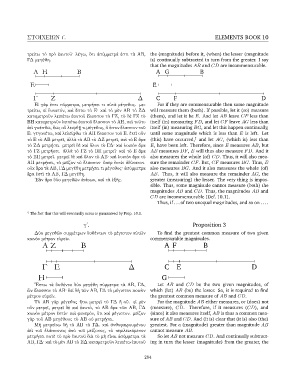
            τρείτω τὸ πρὸ ἑαυτοῦ· λέγω, ὅτι ἀσύμμετρά ἐστι τὰ ΑΒ, the (magnitude) before it, (when) the lesser (magnitude
            ΓΔ μεγέθη.                                          is) continually subtracted in turn from the greater. I say
                                                                that the magnitudes AB and CD are incommensurable.
               Α Η               Β                                A G                B


              Ε                                                  E

               Γ      Ζ                                    ∆      C       F                                   D
               Εἰ γάρ ἐστι σύμμετρα, μετρήσει τι αὐτὰ μέγεθος. με-  For if they are commensurable then some magnitude
            τρείτω, εἰ δυνατόν, καὶ ἔστω τὸ Ε· καὶ τὸ μὲν ΑΒ τὸ ΖΔ will measure them (both). If possible, let it (so) measure
            καταμετροῦν λειπέτω ἑαυτοῦ ἔλασσον τὸ ΓΖ, τὸ δὲ ΓΖ τὸ  (them), and let it be E. And let AB leave CF less than
            ΒΗ καταμετροῦν λειπέτω ἑαυτοῦ ἔλασσον τὸ ΑΗ, καὶ τοῦτο itself (in) measuring FD, and let CF leave AG less than
            ἀεὶ γινέσθω, ἕως οὗ λειφθῇ τι μέγεθος, ὅ ἐστιν ἔλασσον τοῦ itself (in) measuring BG, and let this happen continually,
            Ε. γεγονέτω, καὶ λελείφθω τὸ ΑΗ ἔλασσον τοῦ Ε. ἐπεὶ οὖν until some magnitude which is less than E is left. Let
                                                                                  †
            τὸ Ε τὸ ΑΒ μετρεῖ, ἀλλὰ τὸ ΑΒ τὸ ΔΖ μετρεῖ, καὶ τὸ Ε ἄρα (this) have occurred, and let AG, (which is) less than
            τὸ ΖΔ μετρήσει. μετρεῖ δὲ καὶ ὅλον τὸ ΓΔ· καὶ λοιπὸν ἄρα E, have been left. Therefore, since E measures AB, but
            τὸ ΓΖ μετρήσει. ἀλλὰ τὸ ΓΖ τὸ ΒΗ μετρεῖ· καὶ τὸ Ε ἄρα AB measures DF, E will thus also measure FD. And it
            τὸ ΒΗ μετρεῖ. μετρεῖ δὲ καὶ ὅλον τὸ ΑΒ· καὶ λοιπὸν ἄρα τὸ  also measures the whole (of) CD. Thus, it will also mea-
            ΑΗ μετρήσει, τὸ μεῖζον τὸ ἔλασσον· ὅπερ ἐστὶν ἀδύνατον. sure the remainder CF. But, CF measures BG. Thus, E
            οὐκ ἄρα τὰ ΑΒ, ΓΔ μεγέθη μετρήσει τι μέγεθος· ἀσύμμετρα also measures BG. And it also measures the whole (of)
                                    gþ                          magnitudes AB and CD. Thus, the magnitudes AB and
            ἄρα ἐστὶ τὰ ΑΒ, ΓΔ μεγέθη.                          AB. Thus, it will also measure the remainder AG, the
               ᾿Εὰν ἄρα δύο μεγεθῶν ἀνίσων, καὶ τὰ ἑξῆς.        greater (measuring) the lesser. The very thing is impos-
                                                                sible. Thus, some magnitude cannot measure (both) the

                                                                CD are incommensurable [Def. 10.1].
                                                                   Thus, if . . . of two unequal magnitudes, and so on . . . .

            †  The fact that this will eventually occur is guaranteed by Prop. 10.1.

                                      .
                                                                                  Proposition 3
               Δύο μεγεθῶν συμμέτρων δοθέντων τὸ μέγιστον αὐτῶν    To find the greatest common measure of two given
            κοινὸν μέτρον εὑρεῖν.                               commensurable magnitudes.
                   Α  Ζ            Β                                  A F             B


                   Γ    Ε                              ∆              C    E                              D

                 Η                                                   G
               ῎Εστω τὰ δοθέντα δύο μεγέθη σύμμετρα τὰ ΑΒ, ΓΔ,     Let AB and CD be the two given magnitudes, of
            ὧν ἔλασσον τὸ ΑΒ· δεῖ δὴ τῶν ΑΒ, ΓΔ τὸ μέγιστον κοινὸν which (let) AB (be) the lesser. So, it is required to find
            μέτρον εὑρεῖν.                                      the greatest common measure of AB and CD.
               Τὸ ΑΒ γὰρ μέγεθος ἤτοι μετρεῖ τὸ ΓΔ ἢ οὔ. εἰ μὲν    For the magnitude AB either measures, or (does) not
            οὖν μετρεῖ, μετρεῖ δὲ καὶ ἑαυτό, τὸ ΑΒ ἄρα τῶν ΑΒ, ΓΔ (measure), CD. Therefore, if it measures (CD), and
            κοινὸν μέτρον ἐστίν· καὶ φανερόν, ὅτι καὶ μέγιστον. μεῖζον (since) it also measures itself, AB is thus a common mea-
            γὰρ τοῦ ΑΒ μεγέθους τὸ ΑΒ οὐ μετρήσει.              sure of AB and CD. And (it is) clear that (it is) also (the)
               Μὴ μετρείτω δὴ τὸ ΑΒ τὸ ΓΔ. καὶ ἀνθυφαιρουμένου greatest. For a (magnitude) greater than magnitude AB
            ἀεὶ τοῦ ἐλάσσονος ἀπὸ τοῦ μείζονος, τὸ περιλειπόμενον cannot measure AB.
            μετρήσει ποτὲ τὸ πρὸ ἑαυτοῦ διὰ τὸ μὴ εἶναι ἀσύμμετρα τὰ  So let AB not measure CD. And continually subtract-
            ΑΒ, ΓΔ· καὶ τὸ μὲν ΑΒ τὸ ΕΔ καταμετροῦν λειπέτω ἑαυτοῦ ing in turn the lesser (magnitude) from the greater, the


                                                             284

