


Page 289 - Euclid's Elements of Geometry
P. 289
ST	EW      iþ.


                             Α                                                  A          ELEMENTS BOOK 10
                                    hþ
                             Β                                                  B
               Εἰ γὰρ ἔχει τὸ Α πρὸς τὸ Β λόγον, ὃν ἀριθμὸς πρὸς   For if A has to B the ratio which (some) number (has)
            ἀριθμόν, σύμμετρον ἔσται τὸ Α τῷ Β. οὐκ ἔστι δέ· οὐκ ἄρα to (some) number then A will be commensurable with B
            τὸ Α πρὸς τὸ Β λόγον ἔχει, ὃν ἀριθμὸς πρὸς ἀριθμόν.  [Prop. 10.6]. But it is not. Thus, A does not have to B
               Τὰ ἄρα ἀσύμμετρα μεγέθη πρὸς ἄλληλα λόγον οὐκ ἔχει, the ratio which (some) number (has) to (some) number.
                                                                   Thus, incommensurable numbers do not have to one
            καὶ τὰ ἑξῆς.                                        another, and so on . . . .


                                      .
                                                                                  Proposition 8
               ᾿Εὰν δύο μεγέθη πρὸς ἄλληλα λόγον μὴ ἔχῃ, ὃν ἀριθμὸς  If two magnitudes do not have to one another the ra-
            πρὸς ἀριθμόν, ἀσύμμετρα ἔσται τὰ μεγέθη.            tio which (some) number (has) to (some) number then
                                                                the magnitudes will be incommensurable.
                             Α                                                  A
                             Β                                                  B
               Δύο γὰρ μεγέθη τὰ Α, Β πρὸς ἄλληλα λόγον μὴ ἐχέτω,  For let the two magnitudes A and B not have to one
            ὃν ἀριθμὸς πρὸς ἀριθμόν· λέγω, ὅτι ἀσύμμετρά ἐστι τὰ Α, another the ratio which (some) number (has) to (some)
                                    jþ                          the magnitudes A and B are incommensurable.
            Β μεγέθη.                                           number. I say that the magnitudes A and B are incom-
               Εἰ γὰρ ἔσται σύμμετρα, τὸ Α πρὸς τὸ Β λόγον ἕξει, ὃν mensurable.
            ἀριθμὸς πρὸς ἀριθμόν. οὐκ ἔχει δέ. ἀσύμμετρα ἄρα ἐστὶ τὰ  For if they are commensurable, A will have to B
            Α, Β μεγέθη.                                        the ratio which (some) number (has) to (some) number
               ᾿Εὰν ἄρα δύο μεγέθη πρὸς ἄλληλα, καὶ τὰ ἑξῆς.    [Prop. 10.5]. But it does not have (such a ratio). Thus,
                                                                   Thus, if two magnitudes . . . to one another, and so on
                                                                . . . .

                                                                                  Proposition 9
                                      .
               Τὰ ἀπὸ τῶν μήκει συμμέτρων εὐθειῶν τετράγωνα        Squares on straight-lines (which are) commensurable
            πρὸς ἄλληλα λόγον ἔχει, ὃν τετράγωνος ἀριθμὸς πρὸς  in length have to one another the ratio which (some)
            τετράγωνον ἀριθμόν· καὶ τὰ τετράγωνα τὰ πρὸς ἄλληλα square number (has) to (some) square number. And
            λόγον ἔχοντα, ὃν τετράγωνος ἀριθμὸς πρὸς τετράγωνον squares having to one another the ratio which (some)
            ἀριθμόν, καὶ τὰς πλευρὰς ἕξει μήκει συμμέτρους.  τὰ  square number (has) to (some) square number will also
            δὲ ἀπὸ τῶν μήκει ἀσυμμέτρων εὐθειῶν τετράγωνα πρὸς  have sides (which are) commensurable in length. But
            ἄλληλα λόγον οὐκ ἔχει, ὅνπερ τετράγωνος ἀριθμὸς πρὸς  squares on straight-lines (which are) incommensurable
            τετράγωνον ἀριθμόν· καὶ τὰ τετράγωνα τὰ πρὸς ἄλληλα in length do not have to one another the ratio which
            λόγον μὴ ἔχοντα, ὃν τετράγωνος ἀριθμὸς πρὸς τετράγωνον (some) square number (has) to (some) square number.
            ἀριθμόν, οὐδὲ τὰς πλευρὰς ἕξει μήκει συμμέτρους.    And squares not having to one another the ratio which
                                                                (some) square number (has) to (some) square number
                                                                will not have sides (which are) commensurable in length
                                                                either.
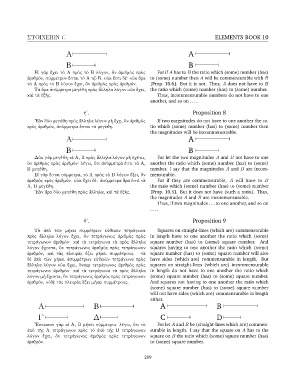
                 Α                      Β                           A                       B

                 Γ                      ∆                           C                       D
               ῎Εστωσαν γὰρ αἱ Α, Β μήκει σύμμετροι· λέγω, ὅτι τὸ  For let A and B be (straight-lines which are) commen-
            ἀπὸ τῆς Α τετράγωνον πρὸς τὸ ἀπὸ τῆς Β τετράγωνον surable in length. I say that the square on A has to the
            λόγον ἔχει, ὃν τετράγωνος ἀριθμὸς πρὸς τετράγωνον square on B the ratio which (some) square number (has)
            ἀριθμόν.                                            to (some) square number.


                                                             289

