


Page 287 - Euclid's Elements of Geometry
P. 287
ST	EW      iþ.      eþ                                                     ELEMENTS BOOK 10


                                      .
                                                                                  Proposition 5
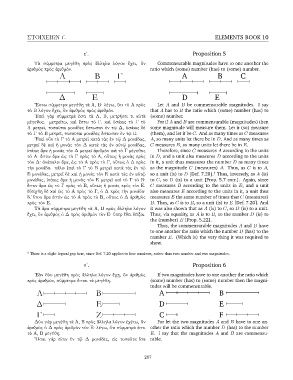
               Τὰ σύμμετρα μεγέθη πρὸς ἄλληλα λόγον ἔχει, ὃν       Commensurable magnitudes have to one another the
            ἀριθμὸς πρὸς ἀριθμόν.                               ratio which (some) number (has) to (some) number.
                          Α              Β        Γ                          A              B         C


                          ∆            Ε                                     D             E

               ῎Εστω σύμμετρα μεγέθη τὰ Α, Β· λέγω, ὅτι τὸ Α πρὸς  Let A and B be commensurable magnitudes. I say
            τὸ Β λόγον ἔχει, ὃν ἀριθμὸς πρὸς ἀριθμόν.           that A has to B the ratio which (some) number (has) to
               ᾿Επεὶ γὰρ σύμμετρά ἐστι τὰ Α, Β, μετρήσει τι αὐτὰ (some) number.
            μέγεθος. μετρείτω, καὶ ἔστω τὸ Γ. καὶ ὁσάκις τὸ Γ τὸ   For if A and B are commensurable (magnitudes) then
            Α μετρεῖ, τοσαῦται μονάδες ἔστωσαν ἐν τῷ Δ, ὁσάκις δὲ  some magnitude will measure them. Let it (so) measure
            τὸ Γ τὸ Β μετρεῖ, τοσαῦται μονάδες ἔστωσαν ἐν τῷ Ε.  (them), and let it be C. And as many times as C measures
               ᾿Επεὶ οὖν τὸ Γ τὸ Α μετρεῖ κατὰ τὰς ἐν τῷ Δ μονάδας, A, so many units let there be in D. And as many times as
            μετρεῖ δὲ καὶ ἡ μονὰς τὸν Δ κατὰ τὰς ἐν αὐτῷ μονάδας, C measures B, so many units let there be in E.
            ἰσάκις ἄρα ἡ μονὰς τὸν Δ μετρεῖ ἀριθμὸν καὶ τὸ Γ μέγεθος  Therefore, since C measures A according to the units
            τὸ Α· ἔστιν ἄρα ὡς τὸ Γ πρὸς τὸ Α, οὕτως ἡ μονὰς πρὸς  in D, and a unit also measures D according to the units
            τὸν Δ· ἀνάπαλιν ἄρα, ὡς τὸ Α πρὸς τὸ Γ, οὕτως ὁ Δ πρὸς  in it, a unit thus measures the number D as many times
            τὴν μονάδα. πάλιν ἐπεὶ τὸ Γ τὸ Β μετρεῖ κατὰ τὰς ἐν τῷ as the magnitude C (measures) A. Thus, as C is to A,
                                                                                          †
            Ε μονάδας, μετρεῖ δὲ καὶ ἡ μονὰς τὸν Ε κατὰ τὰς ἐν αὐτῷ so a unit (is) to D [Def. 7.20]. Thus, inversely, as A (is)
            μονάδας, ἰσάκις ἄρα ἡ μονὰς τὸν Ε μετρεῖ καὶ τὸ Γ τὸ Β· to C, so D (is) to a unit [Prop. 5.7 corr.]. Again, since
            ἔστιν ἄρα ὡς τὸ Γ πρὸς τὸ Β, οὕτως ἡ μονὰς πρὸς τὸν Ε.  C measures B according to the units in E, and a unit
            ἐδείχθη δὲ καὶ ὡς τὸ Α πρὸς τὸ Γ, ὁ Δ πρὸς τὴν μονάδα· also measures E according to the units in it, a unit thus
            δι᾿ ἴσου ἄρα ἐστὶν ὡς τὸ Α πρὸς τὸ Β, οὕτως ὁ Δ ἀριθμὸς measures E the same number of times that C (measures)
            πρὸς τὸν Ε.                                         B. Thus, as C is to B, so a unit (is) to E [Def. 7.20]. And
               Τὰ ἄρα σύμμετρα μεγέθη τὰ Α, Β πρὸς ἄλληλα λόγον it was also shown that as A (is) to C, so D (is) to a unit.
                                    þ                          to one another the ratio which the number D (has) to the
            ἔχει, ὃν ἀριθμὸς ὁ Δ πρὸς ἀριθμὸν τὸν Ε· ὅπερ ἔδει δεῖξαι. Thus, via equality, as A is to B, so the number D (is) to
                                                                the (number) E [Prop. 5.22].
                                                                   Thus, the commensurable magnitudes A and B have

                                                                number E. (Which is) the very thing it was required to
                                                                show.

            †  There is a slight logical gap here, since Def. 7.20 applies to four numbers, rather than two number and two magnitudes.
                                                                                  Proposition 6
                                      .
               ᾿Εὰν δύο μεγέθη πρὸς ἄλληλα λόγον ἔχῃ, ὃν ἀριθμὸς   If two magnitudes have to one another the ratio which
            πρὸς ἀριθμόν, σύμμετρα ἔσται τὰ μεγέθη.             (some) number (has) to (some) number then the magni-
                                                                tudes will be commensurable.
                Α                        Β                          A                        B
                ∆                        Ε                          D                        E

                Γ                        Ζ                          C                        F
               Δύο γὰρ μεγέθη τὰ Α, Β πρὸς ἄλληλα λόγον ἐχέτω, ὃν  For let the two magnitudes A and B have to one an-
            ἀριθμὸς ὁ Δ πρὸς ἀριθμὸν τὸν Ε· λέγω, ὅτι σύμμετρά ἐστι  other the ratio which the number D (has) to the number
            τὰ Α, Β μεγέθη.                                     E. I say that the magnitudes A and B are commensu-
               ῞Οσαι γάρ εἰσιν ἐν τῷ Δ μονάδες, εἰς τοσαῦτα ἴσα rable.


                                                             287

