


Page 324 - Euclid's Elements of Geometry
P. 324
ST	EW      iþ.


                 ′ 2
            [(k − k ) /k] = 0.     ljþ                                                     ELEMENTS BOOK 10
                                                                                 Proposition 39
                                      .
               ᾿Εὰν δύο εὐθεῖαι δυνάμει ἀσύμμετροι συντεθῶσι ποιοῦς-  If two straight-lines (which are) incommensurable in
            αι τὸ μὲν συγκείμενον ἐκ τῶν ἀπ᾿ αὐτῶν τετραγώνων ῥητόν, square, making the sum of the squares on them rational,
            τὸ δ᾿ ὑπ᾿ αὐτῶν μέσον, ἡ ὅλη εὐθεῖα ἄλογός ἐστιν, καλείσθω and the (rectangle contained) by them medial, are added
            δὲ μείζων.                                          together then the whole straight-line is irrational—let it
                                                                be called a major (straight-line).

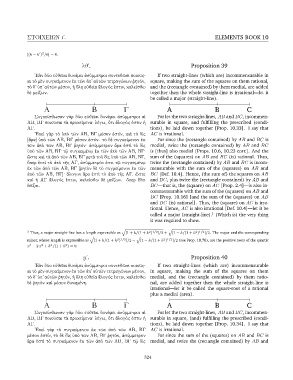
                   Α                   Β             Γ                 A                   B            C
               Συγκείσθωσαν γὰρ δύο εὐθεῖαι δυνάμει ἀσύμμετροι αἱ  For let the two straight-lines, AB and BC, incommen-
            ΑΒ, ΒΓ ποιοῦσαι τὰ προκείμενα· λέγω, ὅτι ἄλογός ἐστιν ἡ  surable in square, and fulfilling the prescribed (condi-
            ΑΓ.                                                 tions), be laid down together [Prop. 10.33]. I say that
               ᾿Επεὶ γὰρ τὸ ὑπὸ τῶν ΑΒ, ΒΓ μέσον ἐστίν, καὶ τὸ δὶς  AC is irrational.
            [ἄρα] ὑπὸ τῶν ΑΒ, ΒΓ μέσον ἐστίν. τὸ δὲ συγκείμενον ἐκ  For since the (rectangle contained) by AB and BC is
            τῶν ἀπὸ τῶν ΑΒ, ΒΓ ῥητόν· ἀσύμμετρον ἄρα ἐστὶ τὸ δὶς  medial, twice the (rectangle contained) by AB and BC
            ὑπὸ τῶν ΑΒ, ΒΓ τῷ συγκειμένῳ ἐκ τῶν ἀπὸ τῶν ΑΒ, ΒΓ· is [thus] also medial [Props. 10.6, 10.23 corr.]. And the
            ὥστε καὶ τὰ ἀπὸ τῶν ΑΒ, ΒΓ μετὰ τοῦ δὶς ὑπὸ τῶν ΑΒ, ΒΓ, sum of the (squares) on AB and BC (is) rational. Thus,
            ὅπερ ἐστὶ τὸ ἀπὸ τῆς ΑΓ, ἀσύμμετρόν ἐστι τῷ συγκειμένῳ twice the (rectangle contained) by AB and BC is incom-
            ἐκ τῶν ἀπὸ τῶν ΑΒ, ΒΓ [ῥητὸν δὲ τὸ συγμείμενον ἐκ τῶν  mensurable with the sum of the (squares) on AB and
            ἀπὸ τῶν ΑΒ, ΒΓ]· ἄλογον ἄρα ἐστὶ τὸ ἀπὸ τῆς ΑΓ. ὥστε  BC [Def. 10.4]. Hence, (the sum of) the squares on AB
            καὶ ἡ ΑΓ ἄλογός ἐστιν, καλείσθω δὲ μείζων. ὅπερ ἔδει and BC, plus twice the (rectangle contained) by AB and
            δεῖξαι.                                             BC—that is, the (square) on AC [Prop. 2.4]—is also in-
                                                                commensurable with the sum of the (squares) on AB and
                                                                BC [Prop. 10.16] [and the sum of the (squares) on AB
                                                                and BC (is) rational]. Thus, the (square) on AC is irra-
                                    mþ              q           called a major (straight-line). (Which is) the very thing
                                                                tional. Hence, AC is also irrational [Def. 10.4]—let it be
                                                                                          †
                                                                it was required to show.

                                                                       q
            †  Thus, a major straight-line has a length expressible as  [1 + k/(1 + k )  ]/2 +  [1 − k/(1 + k )  ]/2. The major and the corresponding
                                                               2 1/2
                                                                                   2 1/2
                                                  2 1/2
                                                                     2 1/2
            minor, whose length is expressible as  q [1 + k/(1 + k )  ]/2 −  q [1 − k/(1 + k )  ]/2 (see Prop. 10.76), are the positive roots of the quartic
             4
                  2
                      2
                            2
            x − 2 x + k /(1 + k ) = 0.
                                      .
                                                                                 Proposition 40
               ᾿Εὰν δύο εὐθεῖαι δυνάμει ἀσύμμετροι συντεθῶσι ποιοῦς-  If two straight-lines (which are) incommensurable
            αι τὸ μὲν συγκείμενον ἐκ τῶν ἀπ᾿ αὐτῶν τετραγώνων μέσον, in square, making the sum of the squares on them
            τὸ δ᾿ ὑπ᾿ αὐτῶν ῥητόν, ἡ ὅλη εὐθεῖα ἄλογός ἐστιν, καλείσθω medial, and the (rectangle contained) by them ratio-
            δὲ ῥητὸν καὶ μέσον δυναμένη.                        nal, are added together then the whole straight-line is
                                                                irrational—let it be called the square-root of a rational
                                                                plus a medial (area).
                   Α                   Β             Γ                 A                   B            C
               Συγκείσθωσαν γὰρ δύο εὐθεῖαι δυνάμει ἀσύμμετροι αἱ  For let the two straight-lines, AB and BC, incommen-
            ΑΒ, ΒΓ ποιοῦσαι τὰ προκείμενα· λέγω, ὅτι ἄλογός ἐστιν ἡ  surable in square, (and) fulfilling the prescribed (condi-
            ΑΓ.                                                 tions), be laid down together [Prop. 10.34]. I say that
               ᾿Επεὶ γὰρ τὸ συγκείμενον ἐκ τῶν ἀπὸ τῶν ΑΒ, ΒΓ   AC is irrational.
            μέσον ἐστίν, τὸ δὲ δὶς ὑπὸ τῶν ΑΒ, ΒΓ ῥητόν, ἀσύμμετρον  For since the sum of the (squares) on AB and BC is
            ἄρα ἐστὶ τὸ συγκείμενον ἐκ τῶν ἀπὸ τῶν ΑΒ, ΒΓ τῷ δὶς  medial, and twice the (rectangle contained) by AB and


                                                             324

