


Page 327 - Euclid's Elements of Geometry
P. 327
ST	EW      iþ.


                                                                                           ELEMENTS BOOK 10


                                                                remaining (rectangle contained) by AC and CB is less
                                                                than the (rectangle contained) by AD and DB. And,
                                   mbþ                          DB. And thus the remaining sum of the (squares) on AC
                                                                hence, twice the (rectangle contained) by AC and CB
                                                                is less than twice the (rectangle contained) by AD and

                                                                and CB is greater than the sum of the (squares) on AD
                                                                        †
                                                                and DB. (Which is) the very thing it was required to
                                                                show.

                           2
                     2
                                                               2
                                                2
                                          2
            †  Since, AC + CB + 2 AC CB = AD + DB + 2 AD DB = AB .
                                      .
                                                                                 Proposition 42
               ῾Η ἐκ δύο ὀνομάτων κατὰ ἓν μόνον σημεῖον διαιρεῖται A binomial (straight-line) can be divided into its (compo-
            εἰς τὰ ὀνόματα.                                     nent) terms at one point only. †
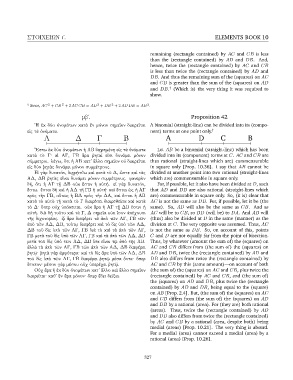
                   Α             ∆        Γ          Β                A             D        C           B
               ῎Εστω ἐκ δύο ὀνομάτων ἡ ΑΒ διῃρημένη εἰς τὰ ὀνόματα  Let AB be a binomial (straight-line) which has been
            κατὰ τὸ Γ· αἱ ΑΓ, ΓΒ ἄρα ῥηταί εἰσι δυνάμει μόνον divided into its (component) terms at C. AC and CB are
            σύμμετροι. λέγω, ὅτι ἡ ΑΒ κατ᾿ ἄλλο σημεῖον οὐ διαιρεῖται thus rational (straight-lines which are) commensurable
            εἰς δύο ῥητὰς δυνάμει μόνον συμμέτρους.             in square only [Prop. 10.36]. I say that AB cannot be
               Εἰ γὰρ δυνατόν, διῃρήσθω καὶ κατὰ τὸ Δ, ὥστε καὶ τὰς divided at another point into two rational (straight-lines
            ΑΔ, ΔΒ ῥητὰς εἶναι δυνάμει μόνον συμμέτρους. φανερὸν which are) commensurable in square only.
            δή, ὅτι ἡ ΑΓ τῇ ΔΒ οὐκ ἔστιν ἡ αὐτή. εἰ γὰρ δυνατόν,   For, if possible, let it also have been divided at D, such
            ἔστω. ἔσται δὴ καὶ ἡ ΑΔ τῇ ΓΒ ἡ αὐτή· καὶ ἔσται ὡς ἡ ΑΓ  that AD and DB are also rational (straight-lines which
            πρὸς τὴν ΓΒ, οὕτως ἡ ΒΔ πρὸς τὴν ΔΑ, καὶ ἔσται ἡ ΑΒ  are) commensurable in square only. So, (it is) clear that
            κατὰ τὸ αὐτὸ τῇ κατὰ τὸ Γ διαιρέσει διαιρεθεῖσα καὶ κατὰ AC is not the same as DB. For, if possible, let it be (the
            τὸ Δ· ὅπερ οὐχ ὑπόκειται. οὐκ ἄρα ἡ ΑΓ τῇ ΔΒ ἐστιν ἡ  same). So, AD will also be the same as CB. And as
            αὐτή. διὰ δὴ τοῦτο καὶ τὰ Γ, Δ σημεῖα οὐκ ἴσον ἀπέχουσι AC will be to CB, so BD (will be) to DA. And AB will
            τῆς διχοτομίας. ᾧ ἄρα διαφέρει τὰ ἀπὸ τῶν ΑΓ, ΓΒ τῶν  (thus) also be divided at D in the same (manner) as the
            ἀπὸ τῶν ΑΔ, ΔΒ, τούτῳ διαφέρει καὶ τὸ δὶς ὑπὸ τῶν ΑΔ,  division at C. The very opposite was assumed. Thus, AC
            ΔΒ τοῦ δὶς ὑπὸ τῶν ΑΓ, ΓΒ διὰ τὸ καὶ τὰ ἀπὸ τῶν ΑΓ, is not the same as DB. So, on account of this, points
            ΓΒ μετὰ τοῦ δὶς ὑπὸ τῶν ΑΓ, ΓΒ καὶ τὰ ἀπὸ τῶν ΑΔ, ΔΒ  C and D are not equally far from the point of bisection.
            μετὰ τοῦ δὶς ὑπὸ τῶν ΑΔ, ΔΒ ἴσα εἶναι τῷ ἀπὸ τῆς ΑΒ. Thus, by whatever (amount the sum of) the (squares) on
            ἀλλὰ τὰ ἀπὸ τῶν ΑΓ, ΓΒ τῶν ἀπὸ τῶν ΑΔ, ΔΒ διαφέρει AC and CB differs from (the sum of) the (squares) on
            ῥητῷ· ῥητὰ γὰρ ἀμφότερα· καὶ τὸ δὶς ἄρα ὑπὸ τῶν ΑΔ, ΔΒ  AD and DB, twice the (rectangle contained) by AD and
            τοῦ δὶς ὑπὸ τῶν ΑΓ, ΓΒ διαφέρει ῥητῷ μέσα ὄντα· ὅπερ DB also differs from twice the (rectangle contained) by
            ἄτοπον· μέσον γὰρ μέσου οὐχ ὑπερέχει ῥητῷ.          AC and CB by this (same amount)—on account of both
               Οὐχ ἄρα ἡ ἐκ δύο ὀνομάτων κατ᾿ ἄλλο καὶ ἄλλο σημεῖον (the sum of) the (squares) on AC and CB, plus twice the
            διαιρεῖται· καθ᾿ ἓν ἄρα μόνον· ὅπερ ἔδει δεῖξαι.    (rectangle contained) by AC and CB, and (the sum of)
                                                                the (squares) on AD and DB, plus twice the (rectangle
                                                                contained) by AD and DB, being equal to the (square)
                                                                on AB [Prop. 2.4]. But, (the sum of) the (squares) on AC
                                                                and CB differs from (the sum of) the (squares) on AD
                                                                and DB by a rational (area). For (they are) both rational
                                                                (areas). Thus, twice the (rectangle contained) by AD
                                                                and DB also differs from twice the (rectangle contained)
                                                                by AC and CB by a rational (area, despite both) being
                                                                medial (areas) [Prop. 10.21]. The very thing is absurd.
                                                                For a medial (area) cannot exceed a medial (area) by a
                                                                rational (area) [Prop. 10.26].


                                                             327

