


Page 35 - Euclid's Elements of Geometry
P. 35
ST	EW      aþ.


                                                                                            ELEMENTS BOOK 1


               Κοινὴ προσκείσθω ἡ ὑπὸ ΑΓΒ· αἱ ἄρα ὑπὸ ΑΓΔ, ΑΓΒ  gle ACD is equal to the (sum of the) two internal and
            τρισὶ ταῖς ὑπὸ ΑΒΓ, ΒΓΑ, ΓΑΒ ἴσαι εἰσίν. ἀλλ᾿ αἱ ὑπὸ ΑΓΔ, opposite (angles) BAC and ABC.
            ΑΓΒ δυσὶν ὀρθαῖς ἴσαι εἰσίν· καὶ αἱ ὑπὸ ΑΓΒ, ΓΒΑ, ΓΑΒ  Let ACB have been added to both. Thus, (the sum
            ἄρα δυσὶν ὀρθαῖς ἴσαι εἰσίν.                        of) ACD and ACB is equal to the (sum of the) three
               Παντὸς ἄρα τριγώνου μιᾶς τῶν πλευρῶν προσεκ- (angles) ABC, BCA, and CAB. But, (the sum of) ACD
            βληθείσης ἡ ἐκτὸς γωνία δυσὶ ταῖς ἐντὸς καὶ ἀπεναντίον and ACB is equal to two right-angles [Prop. 1.13]. Thus,
                                   lgþ                          duced (then) the external angle is equal to the (sum of
            ἴση ἐστίν, καὶ αἱ ἐντὸς τοῦ τριγώνου τρεῖς γωνίαι δυσὶν (the sum of) ACB, CBA, and CAB is also equal to two
            ὀρθαῖς ἴσαι εἰσίν· ὅπερ ἔδει δεῖξαι.                right-angles.
                                                                   Thus, in any triangle, (if) one of the sides (is) pro-
                                                                the) two internal and opposite (angles), and the (sum of
                                                                the) three internal angles of the triangle is equal to two
                                                                right-angles. (Which is) the very thing it was required to
                                                                show.

                                                                                 Proposition 33
                                      .
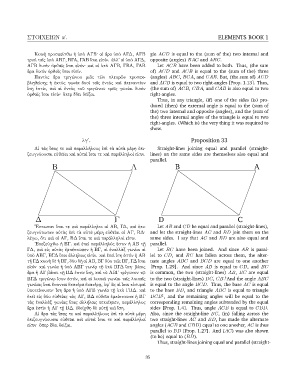
               Αἱ τὰς ἴσας τε καὶ παραλλήλους ἐπὶ τὰ αὐτὰ μέρη ἐπι-  Straight-lines joining equal and parallel (straight-
            ζευγνύουσαι εὐθεῖαι καὶ αὐταὶ ἴσαι τε καὶ παράλληλοί εἰσιν. lines) on the same sides are themselves also equal and
                                                                parallel.
                       Β                                Α                 B                                A


                ∆                                Γ                 D                                C
               ῎Εστωσαν ἴσαι τε καὶ παράλληλοι αἱ ΑΒ, ΓΔ, καὶ ἐπι-  Let AB and CD be equal and parallel (straight-lines),
            ζευγνύτωσαν αὐτὰς ἐπὶ τὰ αὐτὰ μέρη εὐθεῖαι αἱ ΑΓ, ΒΔ· and let the straight-lines AC and BD join them on the
            λέγω, ὅτι καὶ αἱ ΑΓ, ΒΔ ἴσαι τε καὶ παράλληλοί εἰσιν.  same sides. I say that AC and BD are also equal and
               ᾿Επεζεύχθω ἡ ΒΓ. καὶ ἐπεὶ παράλληλός ἐστιν ἡ ΑΒ τῇ  parallel.
            ΓΔ, καὶ εἰς αὐτὰς ἐμπέπτωκεν ἡ ΒΓ, αἱ ἐναλλὰξ γωνίαι αἱ  Let BC have been joined. And since AB is paral-
            ὑπὸ ΑΒΓ, ΒΓΔ ἴσαι ἀλλήλαις εἰσίν. καὶ ἐπεὶ ἴση ἐστὶν ἡ ΑΒ  lel to CD, and BC has fallen across them, the alter-
            τῇ ΓΔ κοινὴ δὲ ἡ ΒΓ, δύο δὴ αἱ ΑΒ, ΒΓ δύο ταῖς ΒΓ, ΓΔ ἴσαι nate angles ABC and BCD are equal to one another
            εἰσίν· καὶ γωνία ἡ ὑπὸ ΑΒΓ γωνίᾳ τῇ ὑπὸ ΒΓΔ ἴση· βάσις [Prop. 1.29]. And since AB is equal to CD, and BC
            ἄρα ἡ ΑΓ βάσει τῇ ΒΔ ἐστιν ἴση, καὶ τὸ ΑΒΓ τρίγωνον τῷ is common, the two (straight-lines) AB, BC are equal
                                                                                               †
            ΒΓΔ τριγώνῳ ἴσον ἐστίν, καὶ αἱ λοιπαὶ γωνίαι ταῖς λοιπαῖς to the two (straight-lines) DC, CB. And the angle ABC
            γωνίαις ἴσαι ἔσονται ἑκατέρα ἑκατέρᾳ, ὑφ᾿ ἃς αἱ ἴσαι πλευραὶ is equal to the angle BCD. Thus, the base AC is equal
            ὑποτείνουσιν· ἴση ἄρα ἡ ὑπὸ ΑΓΒ γωνία τῇ ὑπὸ ΓΒΔ. καὶ to the base BD, and triangle ABC is equal to triangle
                                                                     ‡
            ἐπεὶ εἰς δύο εὐθείας τὰς ΑΓ, ΒΔ εὐθεῖα ἐμπίπτουσα ἡ ΒΓ  DCB , and the remaining angles will be equal to the
            τὰς ἐναλλὰξ γωνίας ἴσας ἀλλήλαις πεποίηκεν, παράλληλος corresponding remaining angles subtended by the equal
            ἄρα ἐστὶν ἡ ΑΓ τῇ ΒΔ. ἐδείχθη δὲ αὐτῇ καὶ ἴση.      sides [Prop. 1.4]. Thus, angle ACB is equal to CBD.
               Αἱ ἄρα τὰς ἴσας τε καὶ παραλλήλους ἐπὶ τὰ αὐτὰ μέρη  Also, since the straight-line BC, (in) falling across the
            ἐπιζευγνύουσαι εὐθεῖαι καὶ αὐταὶ ἴσαι τε καὶ παράλληλοί two straight-lines AC and BD, has made the alternate
            εἰσιν· ὅπερ ἔδει δεῖξαι.                            angles (ACB and CBD) equal to one another, AC is thus
                                                                parallel to BD [Prop. 1.27]. And (AC) was also shown
                                                                (to be) equal to (BD).
                                                                   Thus, straight-lines joining equal and parallel (straight-

                                                              35

