


Page 32 - Euclid's Elements of Geometry
P. 32
ST	EW      aþ.


                                                                                            ELEMENTS BOOK 1

                                   kjþ                          internal (angles) on the same side equal to two right-
            ποιῇ ἢ τὰς ἐντὸς καὶ ἐπὶ τὰ αὐτὰ μέρη δυσὶν ὀρθαῖς ἴσας,  Thus, if a straight-line falling across two straight-lines
            παράλληλοι ἔσονται αἱ εὐθεῖαι· ὅπερ ἔδει δεῖξαι.    makes the external angle equal to the internal and oppo-
                                                                site angle on the same side, or (makes) the (sum of the)


                                                                angles, then the (two) straight-lines will be parallel (to
                                                                one another). (Which is) the very thing it was required
                                                                to show.


                                      .
                                                                                 Proposition 29
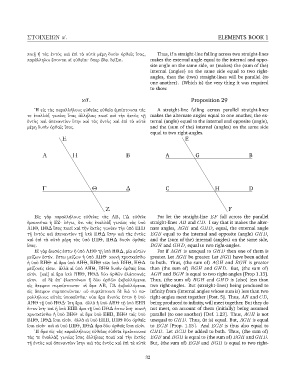
               ῾Η εἰς τὰς παραλλήλους εὐθείας εὐθεῖα ἐμπίπτουσα τάς  A straight-line falling across parallel straight-lines
            τε ἐναλλὰξ γωνίας ἴσας ἀλλήλαις ποιεῖ καὶ τὴν ἐκτὸς τῇ  makes the alternate angles equal to one another, the ex-
            ἐντὸς καὶ ἀπεναντίον ἴσην καὶ τὰς ἐντὸς καὶ ἐπὶ τὰ αὐτὰ ternal (angle) equal to the internal and opposite (angle),
            μέρη δυσὶν ὀρθαῖς ἴσας.                             and the (sum of the) internal (angles) on the same side
                                                                equal to two right-angles.
                           Ε                                                  E


                   Α           Η                      Β               A            G                     B


                   Γ                   Θ              ∆               C                    H             D


                                             Ζ                                                   F
               Εἰς γὰρ παραλλήλους εὐθείας τὰς ΑΒ, ΓΔ εὐθεῖα       For let the straight-line EF fall across the parallel
            ἐμπιπτέτω ἡ ΕΖ· λέγω, ὅτι τὰς ἐναλλὰξ γωνίας τὰς ὑπὸ straight-lines AB and CD. I say that it makes the alter-
            ΑΗΘ, ΗΘΔ ἴσας ποιεῖ καὶ τὴν ἐκτὸς γωνίαν τὴν ὑπὸ ΕΗΒ  nate angles, AGH and GHD, equal, the external angle
            τῇ ἐντὸς καὶ ἀπεναντίον τῇ ὑπὸ ΗΘΔ ἴσην καὶ τὰς ἐντὸς  EGB equal to the internal and opposite (angle) GHD,
            καὶ ἐπὶ τὰ αὐτὰ μέρη τὰς ὑπὸ ΒΗΘ, ΗΘΔ δυσὶν ὀρθαῖς and the (sum of the) internal (angles) on the same side,
            ἴσας.                                               BGH and GHD, equal to two right-angles.
               Εἰ γὰρ ἄνισός ἐστιν ἡ ὑπὸ ΑΗΘ τῇ ὑπὸ ΗΘΔ, μία αὐτῶν  For if AGH is unequal to GHD then one of them is
            μείζων ἐστίν. ἔστω μείζων ἡ ὑπὸ ΑΗΘ· κοινὴ προσκείσθω greater. Let AGH be greater. Let BGH have been added
            ἡ ὑπὸ ΒΗΘ· αἱ ἄρα ὑπὸ ΑΗΘ, ΒΗΘ τῶν ὑπὸ ΒΗΘ, ΗΘΔ to both. Thus, (the sum of) AGH and BGH is greater
            μείζονές εἰσιν. ἀλλὰ αἱ ὑπὸ ΑΗΘ, ΒΗΘ δυσὶν ὀρθαῖς ἴσαι than (the sum of) BGH and GHD. But, (the sum of)
            εἰσίν. [καὶ] αἱ ἄρα ὑπὸ ΒΗΘ, ΗΘΔ δύο ὀρθῶν ἐλάσσονές AGH and BGH is equal to two right-angles [Prop 1.13].
            εἰσιν.  αἱ δὲ ἀπ᾿ ἐλασσόνων ἢ δύο ὀρθῶν ἐκβαλλόμεναι Thus, (the sum of) BGH and GHD is [also] less than
            εἰς ἄπειρον συμπίπτουσιν· αἱ ἄρα ΑΒ, ΓΔ ἐκβαλλόμεναι two right-angles. But (straight-lines) being produced to
            εἰς ἄπειρον συμπεσοῦνται· οὐ συμπίπτουσι δὲ διὰ τὸ πα- infinity from (internal angles whose sum is) less than two
            ραλλήλους αὐτὰς ὑποκεῖσθαι· οὐκ ἄρα ἄνισός ἐστιν ἡ ὑπὸ right-angles meet together [Post. 5]. Thus, AB and CD,
            ΑΗΘ τῇ ὑπὸ ΗΘΔ· ἴση ἄρα. ἀλλὰ ἡ ὑπὸ ΑΗΘ τῇ ὑπὸ ΕΗΒ  being produced to infinity, will meet together. But they do
            ἐστιν ἴση· καὶ ἡ ὑπὸ ΕΗΒ ἄρα τῇ ὑπὸ ΗΘΔ ἐστιν ἴση· κοινὴ not meet, on account of them (initially) being assumed
            προσκείσθω ἡ ὑπὸ ΒΗΘ· αἱ ἄρα ὑπὸ ΕΗΒ, ΒΗΘ ταῖς ὑπὸ parallel (to one another) [Def. 1.23]. Thus, AGH is not
            ΒΗΘ, ΗΘΔ ἴσαι εἰσίν. ἀλλὰ αἱ ὑπὸ ΕΗΒ, ΒΗΘ δύο ὀρθαῖς unequal to GHD. Thus, (it is) equal. But, AGH is equal
            ἴσαι εἰσίν· καὶ αἱ ὑπὸ ΒΗΘ, ΗΘΔ ἄρα δύο ὀρθαῖς ἴσαι εἰσίν. to EGB [Prop. 1.15]. And EGB is thus also equal to
               ῾Η ἄρα εἰς τὰς παραλλήλους εὐθείας εὐθεῖα ἐμπίπτουσα GHD. Let BGH be added to both. Thus, (the sum of)
            τάς τε ἐναλλὰξ γωνίας ἴσας ἀλλήλαις ποιεῖ καὶ τὴν ἐκτὸς EGB and BGH is equal to (the sum of) BGH and GHD.
            τῇ ἐντὸς καὶ ἀπεναντίον ἴσην καὶ τὰς ἐντὸς καὶ ἐπὶ τὰ αὐτὰ But, (the sum of) EGB and BGH is equal to two right-

                                                              32

