


Page 61 - Euclid's Elements of Geometry
P. 61
ST	EW      bþ.      iþ                                                      ELEMENTS BOOK 2


                                                                                Proposition 10
                                     .
                                                                                                †
               ᾿Εὰν εὐθεῖα γραμμὴ τμηθῇ δίχα, προστεθῇ δέ τις αὐτῇ  If a straight-line is cut in half, and any straight-line
            εὐθεῖα ἐπ᾿ εὐθείας, τὸ ἀπὸ τῆς ὅλης σὺν τῇ προσκειμένῃ added to it straight-on, then the sum of the square on
            καὶ τὸ ἀπὸ τῆς προσκειμένης τὰ συναμφότερα τετράγωνα  the whole (straight-line) with the (straight-line) having
            διπλάσιά ἐστι τοῦ τε ἀπὸ τῆς ἡμισείας καὶ τοῦ ἀπὸ τῆς συγ-  been added, and the (square) on the (straight-line) hav-
            κειμένης ἔκ τε τῆς ἡμισείας καὶ τῆς προσκειμένης ὡς ἀπὸ ing been added, is double the (sum of the square) on half
            μιᾶς ἀναγραφέντος τετραγώνου.                       (the straight-line), and the square described on the sum
                                                                of half (the straight-line) and (straight-line) having been
                                                                added, as on one (complete straight-line).
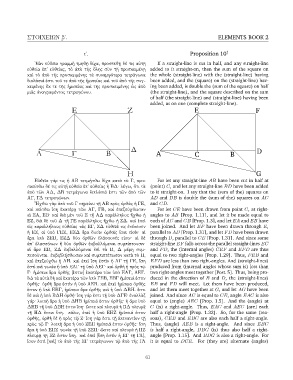
                               Ε                      Ζ                           E                         F


                                                        ∆                                                   D
                Α              Γ             Β                    A               C              B


                                                      Η                                                     G
               Εὐθεῖα γάρ τις ἡ ΑΒ τετμήσθω δίχα κατὰ τὸ Γ, προ-   For let any straight-line AB have been cut in half at
            σκείσθω δέ τις αὐτῇ εὐθεῖα ἐπ᾿ εὐθείας ἡ ΒΔ· λέγω, ὅτι τὰ  (point) C, and let any straight-line BD have been added
            ἀπὸ τῶν ΑΔ, ΔΒ τετράγωνα διπλάσιά ἐστι τῶν ἀπὸ τῶν  to it straight-on. I say that the (sum of the) squares on
            ΑΓ, ΓΔ τετραγώνων.                                  AD and DB is double the (sum of the) squares on AC
               ῎Ηχθω γὰρ ἀπὸ τοῦ Γ σημείου τῇ ΑΒ πρὸς ὀρθὰς ἡ ΓΕ, and CD.
            καὶ κείσθω ἴση ἑκατέρᾳ τῶν ΑΓ, ΓΒ, καὶ ἐπεζεύχθωσαν    For let CE have been drawn from point C, at right-
            αἱ ΕΑ, ΕΒ· καὶ διὰ μὲν τοῦ Ε τῇ ΑΔ παράλληλος ἤχθω ἡ  angles to AB [Prop. 1.11], and let it be made equal to
            ΕΖ, διὰ δὲ τοῦ Δ τῇ ΓΕ παράλληλος ἤχθω ἡ ΖΔ. καὶ ἐπεὶ each of AC and CB [Prop. 1.3], and let EA and EB have
            εἰς παραλλήλους εὐθείας τὰς ΕΓ, ΖΔ εὐθεῖά τις ἐνέπεσεν been joined. And let EF have been drawn through E,
            ἡ ΕΖ, αἱ ὑπὸ ΓΕΖ, ΕΖΔ ἄρα δυσὶν ὀρθαῖς ἴσαι εἰσίν· αἱ parallel to AD [Prop. 1.31], and let FD have been drawn
            ἄρα ὑπὸ ΖΕΒ, ΕΖΔ δύο ὀρθῶν ἐλάσσονές εἰσιν· αἱ δὲ   through D, parallel to CE [Prop. 1.31]. And since some
            ἀπ᾿ ἐλασσόνων ἢ δύο ὀρθῶν ἐκβαλλόμεναι συμπίπτουσιν· straight-line EF falls across the parallel straight-lines EC
            αἱ ἄρα ΕΒ, ΖΔ ἐκβαλλόμεναι ἐπὶ τὰ Β, Δ μέρη συμ-    and FD, the (internal angles) CEF and EFD are thus
            πεσοῦνται. ἐκβεβλήσθωσαν καὶ συμπιπτέτωσαν κατὰ τὸ Η, equal to two right-angles [Prop. 1.29]. Thus, FEB and
            καὶ ἐπεζεύχθω ἡ ΑΗ. καὶ ἐπεὶ ἴση ἐστὶν ἡ ΑΓ τῇ ΓΕ, ἴση EFD are less than two right-angles. And (straight-lines)
            ἐστὶ καὶ γωνία ἡ ὑπὸ ΕΑΓ τῇ ὑπὸ ΑΕΓ· καὶ ὀρθὴ ἡ πρὸς τῷ produced from (internal angles whose sum is) less than
            Γ· ἡμίσεια ἄρα ὀρθῆς [ἐστιν] ἑκατέρα τῶν ὑπὸ ΕΑΓ, ΑΕΓ.  two right-angles meet together [Post. 5]. Thus, being pro-
            διὰ τὰ αὐτὰ δὴ καὶ ἑκατέρα τῶν ὑπὸ ΓΕΒ, ΕΒΓ ἡμίσειά ἐστιν duced in the direction of B and D, the (straight-lines)
            ὀρθῆς· ὀρθὴ ἄρα ἐστὶν ἡ ὑπὸ ΑΕΒ. καὶ ἐπεὶ ἡμίσεια ὀρθῆς  EB and FD will meet. Let them have been produced,
            ἐστιν ἡ ὑπὸ ΕΒΓ, ἡμίσεια ἄρα ὀρθῆς καὶ ἡ ὑπὸ ΔΒΗ. ἔστι  and let them meet together at G, and let AG have been
            δὲ καὶ ἡ ὑπὸ ΒΔΗ ὀρθή· ἴση γάρ ἐστι τῇ ὑπὸ ΔΓΕ· ἐναλλὰξ joined. And since AC is equal to CE, angle EAC is also
            γάρ· λοιπὴ ἅρα ἡ ὑπὸ ΔΗΒ ἡμίσειά ἐστιν ὀρθῆς· ἡ ἄρα ὑπὸ equal to (angle) AEC [Prop. 1.5]. And the (angle) at
            ΔΗΒ τῇ ὑπὸ ΔΒΗ ἐστιν ἴση· ὥστε καὶ πλευρὰ ἡ ΒΔ πλευρᾷ C (is) a right-angle. Thus, EAC and AEC [are] each
            τῇ ΗΔ ἐστιν ἴση. πάλιν, ἐπεὶ ἡ ὑπὸ ΕΗΖ ἡμίσειά ἐστιν half a right-angle [Prop. 1.32]. So, for the same (rea-
            ὀρθῆς, ὀρθὴ δὲ ἡ πρὸς τῷ Ζ· ἴση γάρ ἐστι τῇ ἀπεναντίον τῇ  sons), CEB and EBC are also each half a right-angle.
            πρὸς τῷ Γ· λοιπὴ ἄρα ἡ ὑπὸ ΖΕΗ ἡμίσειά ἐστιν ὀρθῆς· ἴση Thus, (angle) AEB is a right-angle. And since EBC
            ἄρα ἡ ὑπὸ ΕΗΖ γωνία τῇ ὑπὸ ΖΕΗ· ὥστε καὶ πλευρὰ ἡ ΗΖ  is half a right-angle, DBG (is) thus also half a right-
            πλευρᾷ τῇ ΕΖ ἐστιν ἴση. καὶ ἐπεὶ [ἴση ἐστὶν ἡ ΕΓ τῇ ΓΑ], angle [Prop. 1.15]. And BDG is also a right-angle. For
            ἴσον ἐστὶ [καὶ] τὸ ἀπὸ τῆς ΕΓ τετράγωνον τῷ ἀπὸ τῆς ΓΑ it is equal to DCE. For (they are) alternate (angles)


                                                              61

