


Page 66 - Euclid's Elements of Geometry
P. 66
ST	EW      bþ.


                                                                                            ELEMENTS BOOK 2


            τῶν ἀπὸ τῶν ΓΒ, ΒΑ τετραγώνων τῷ δὶς ὑπὸ τῶν ΓΒ, ΒΔ And the (square) on AC (is) equal to the (sum of the
            περιεχομένῳ ὀρθογωνίῳ.                              squares) on AD and DC [Prop. 1.47]. Thus, the (sum of
               ᾿Εν ἄρα τοῖς ὀξυγωνίοις τριγώνοις τὸ ἀπὸ τῆς τὴν ὀξεῖαν the squares) on CB and BA is equal to the (square) on
            γωνίαν ὑποτεινούσης πλευρᾶς τετράγωνον ἔλαττόν ἐστι  AC, and twice the (rectangle contained) by CB and BD.
            τῶν ἀπὸ τῶν τὴν ὀξεῖαν γωνίαν περιεχουσῶν πλευρῶν τε- So the (square) on AC alone is less than the (sum of the)
            τραγώνων τῷ περιεχομένῳ δὶς ὑπό τε μιᾶς τῶν περὶ τὴν squares on CB and BA by twice the rectangle contained
            ὀξεῖαν γωνίαν, ἐφ᾿ ἣν ἡ κάθετος πίπτει, καὶ τῆς ἀπολαμβα- by CB and BD.
            νομένης ἐντὸς ὑπὸ τῆς καθέτου πρὸς τῇ ὀξείᾳ γωνίᾳ· ὅπερ  Thus, in acute-angled triangles, the square on the side
            ἔδει δεῖξαι.                                        subtending the acute angle is less than the (sum of the)
                                    idþ                         acute angle, to which a perpendicular (straight-line) falls,
                                                                squares on the sides containing the acute angle by twice
                                                                the (rectangle) contained by one of the sides around the

                                                                and the (straight-line) cut off inside (the triangle) by
                                                                the perpendicular (straight-line) towards the acute angle.
                                                                (Which is) the very thing it was required to show.

            †  This proposition is equivalent to the well-known cosine formula: AC  2  = AB + BC − 2 AB BC cos ABC, since cos ABC = BD/AB.
                                                                          2
                                                                    2
                                      .
                                                                                 Proposition 14
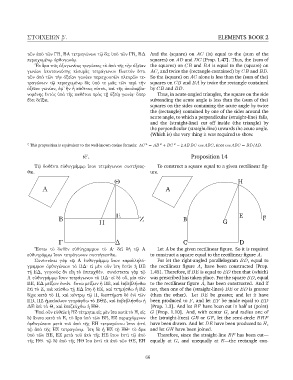
               Τῷ δοθέντι εὐθυγράμμῳ ἴσον τετράγωνον συστήσας-     To construct a square equal to a given rectilinear fig-
            θαι.                                                ure.

                                                 Θ                                                   H
                   Α                                                  A


                                                 Ε                                                   E
                          Β                                Ζ                  B                                F
                                          Η                                                   G


                          Γ                      ∆                            C                      D
               ῎Εστω τὸ δοθὲν εὐθύγραμμον τὸ Α· δεῖ δὴ τῷ Α        Let A be the given rectilinear figure. So it is required
            εὐθυγράμμῳ ἴσον τετράγωνον συστήσασθαι.             to construct a square equal to the rectilinear figure A.
               Συνεστάτω γὰρ τῷ Α ἐυθυγράμμῳ ἴσον παραλληλό-       For let the right-angled parallelogram BD, equal to
            γραμμον ὀρθογώνιον τὸ ΒΔ· εἰ μὲν οὖν ἴση ἐστὶν ἡ ΒΕ the rectilinear figure A, have been constructed [Prop.
            τῇ ΕΔ, γεγονὸς ἂν εἴη τὸ ἐπιταχθέν. συνέσταται γὰρ τῷ 1.45]. Therefore, if BE is equal to ED then that (which)
            Α εὐθυγράμμῳ ἴσον τετράγωνον τὸ ΒΔ· εἰ δὲ οὔ, μία τῶν  was prescribed has taken place. For the square BD, equal
            ΒΕ, ΕΔ μείζων ἐστίν. ἔστω μείζων ἡ ΒΕ, καὶ ἐκβεβλήσθω to the rectilinear figure A, has been constructed. And if
            ἐπὶ τὸ Ζ, καὶ κείσθω τῇ ΕΔ ἴση ἡ ΕΖ, καὶ τετμήσθω ἡ ΒΖ  not, then one of the (straight-lines) BE or ED is greater
            δίχα κατὰ τὸ Η, καὶ κέντρῳ τῷ Η, διαστήματι δὲ ἑνὶ τῶν  (than the other). Let BE be greater, and let it have
            ΗΒ, ΗΖ ἡμικύκλιον γεγράφθω τὸ ΒΘΖ, καὶ ἐκβεβλήσθω ἡ  been produced to F, and let EF be made equal to ED
            ΔΕ ἐπὶ τὸ Θ, καὶ ἐπεζεύχθω ἡ ΗΘ.                    [Prop. 1.3]. And let BF have been cut in half at (point)
               ᾿Επεὶ οὖν εὐθεῖα ἡ ΒΖ τέτμηται εἰς μὲν ἴσα κατὰ τὸ Η, εἰς G [Prop. 1.10]. And, with center G, and radius one of
            δὲ ἄνισα κατὰ τὸ Ε, τὸ ἄρα ὑπὸ τῶν ΒΕ, ΕΖ περιεχόμενον the (straight-lines) GB or GF, let the semi-circle BHF
            ὀρθογώνιον μετὰ τοῦ ἀπὸ τῆς ΕΗ τετραγώνου ἴσον ἐστὶ  have been drawn. And let DE have been produced to H,
            τῷ ἀπὸ τῆς ΗΖ τετραγώνῳ. ἴση δὲ ἡ ΗΖ τῇ ΗΘ· τὸ ἄρα and let GH have been joined.
            ὑπὸ τῶν ΒΕ, ΕΖ μετὰ τοῦ ἀπὸ τῆς ΗΕ ἴσον ἐστὶ τῷ ἀπὸ    Therefore, since the straight-line BF has been cut—
            τῆς ΗΘ. τῷ δὲ ἀπὸ τῆς ΗΘ ἴσα ἐστὶ τὰ ἀπὸ τῶν ΘΕ, ΕΗ  equally at G, and unequally at E—the rectangle con-


                                                              66

