


Page 64 - Euclid's Elements of Geometry
P. 64
ST	EW      bþ.                                                              ELEMENTS BOOK 2


                                    ibþ                         and BH is equal to the square on HA.
                                                                   Thus, the given straight-line AB has been cut at
                                                                (point) H such as to make the rectangle contained by
                                                                AB and BH equal to the square on HA. (Which is) the
                                                                very thing it was required to do.
            †  This manner of cutting a straight-line—so that the ratio of the whole to the larger piece is equal to the ratio of the larger to the smaller piece—is
            sometimes called the “Golden Section”.

                                      .
                                                                                Proposition 12
                                                                                                †
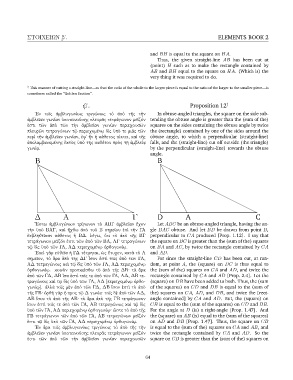
               ᾿Εν τοῖς ἀμβλυγωνίοις τριγώνοις τὸ ἀπὸ τῆς τὴν      In obtuse-angled triangles, the square on the side sub-
            ἀμβλεῖαν γωνίαν ὑποτεινούσης πλευρᾶς τετράγωνον μεῖζόν tending the obtuse angle is greater than the (sum of the)
            ἐστι τῶν ἀπὸ τῶν τὴν ἀμβλεῖαν γωνίαν περιεχουσῶν squares on the sides containing the obtuse angle by twice
            πλευρῶν τετραγώνων τῷ περιεχομένῳ δὶς ὑπὸ τε μιᾶς τῶν  the (rectangle) contained by one of the sides around the
            περὶ τὴν ἀμβλεῖαν γωνίαν, ἐφ᾿ ἣν ἡ κάθετος πίπτει, καὶ τῆς obtuse angle, to which a perpendicular (straight-line)
            ἀπολαμβανομένης ἐκτὸς ὑπὸ τῆς καθέτου πρὸς τῇ ἀμβλείᾳ falls, and the (straight-line) cut off outside (the triangle)
            γωνίᾳ.                                              by the perpendicular (straight-line) towards the obtuse
                                                                angle.
                Β                                                  B


                ∆          Α                            Γ          D           A                            C
               ῎Εστω ἀμβλυγώνιον τρίγωνον τὸ ΑΒΓ ἀμβλεῖαν ἔχον     Let ABC be an obtuse-angled triangle, having the an-
            τὴν ὑπὸ ΒΑΓ, καὶ ἤχθω ἀπὸ τοῦ Β σημείου ἐπὶ τὴν ΓΑ gle BAC obtuse. And let BD be drawn from point B,
            ἐκβληθεῖσαν κάθετος ἡ ΒΔ. λέγω, ὅτι τὸ ἀπὸ τῆς ΒΓ   perpendicular to CA produced [Prop. 1.12]. I say that
            τετράγωνον μεῖζόν ἐστι τῶν ἀπὸ τῶν ΒΑ, ΑΓ τετραγώνων  the square on BC is greater than the (sum of the) squares
            τῷ δὶς ὑπὸ τῶν ΓΑ, ΑΔ περιεχομένῳ ὀρθογωνίῳ.        on BA and AC, by twice the rectangle contained by CA
               ᾿Επεὶ γὰρ εὐθεῖα ἡ ΓΔ τέτμηται, ὡς ἔτυχεν, κατὰ τὸ Α and AD.
            σημεῖον, τὸ ἄρα ἀπὸ τῆς ΔΓ ἴσον ἐστὶ τοῖς ἀπὸ τῶν ΓΑ,  For since the straight-line CD has been cut, at ran-
            ΑΔ τετραγώνοις καὶ τῷ δὶς ὑπὸ τῶν ΓΑ, ΑΔ περιεχομένῳ dom, at point A, the (square) on DC is thus equal to
            ὀρθογωνίῳ. κοινὸν προσκείσθω τὸ ἀπὸ τῆς ΔΒ· τὰ ἄρα the (sum of the) squares on CA and AD, and twice the
            ἀπὸ τῶν ΓΔ, ΔΒ ἴσα ἐστὶ τοῖς τε ἀπὸ τῶν ΓΑ, ΑΔ, ΔΒ τε- rectangle contained by CA and AD [Prop. 2.4]. Let the
            τραγώνοις καὶ τῷ δὶς ὑπὸ τῶν ΓΑ, ΑΔ [περιεχομένῳ ὀρθο-  (square) on DB have been added to both. Thus, the (sum
            γωνίῳ]. ἀλλὰ τοῖς μὲν ἀπὸ τῶν ΓΔ, ΔΒ ἴσον ἐστὶ τὸ ἀπὸ of the squares) on CD and DB is equal to the (sum of
            τῆς ΓΒ· ὀρθὴ γὰρ ἡ προς τῷ Δ γωνία· τοῖς δὲ ἀπὸ τῶν ΑΔ,  the) squares on CA, AD, and DB, and twice the [rect-
            ΔΒ ἴσον τὸ ἀπὸ τῆς ΑΒ· τὸ ἄρα ἀπὸ τῆς ΓΒ τετράγωνον angle contained] by CA and AD. But, the (square) on
            ἴσον ἐστὶ τοῖς τε ἀπὸ τῶν ΓΑ, ΑΒ τετραγώνοις καὶ τῷ δὶς  CB is equal to the (sum of the squares) on CD and DB.
            ὑπὸ τῶν ΓΑ, ΑΔ περιεχομένῳ ὀρθογωνίῳ· ὥστε τὸ ἀπὸ τῆς For the angle at D (is) a right-angle [Prop. 1.47]. And
            ΓΒ τετράγωνον τῶν ἀπὸ τῶν ΓΑ, ΑΒ τετραγώνων μεῖζόν the (square) on AB (is) equal to the (sum of the squares)
            ἐστι τῷ δὶς ὑπὸ τῶν ΓΑ, ΑΔ περιεχομένῳ ὀρθογωνίῳ.   on AD and DB [Prop. 1.47]. Thus, the square on CB
               ᾿Εν ἄρα τοῖς ἀμβλυγωνίοις τριγώνοις τὸ ἀπὸ τῆς τὴν is equal to the (sum of the) squares on CA and AB, and
            ἀμβλεῖαν γωνίαν ὑποτεινούσης πλευρᾶς τετράγωνον μεῖζόν twice the rectangle contained by CA and AD. So the
            ἐστι τῶν ἀπὸ τῶν τὴν ἀμβλεῖαν γωνίαν περιεχουσῶν square on CB is greater than the (sum of the) squares on


                                                              64

