


Page 83 - Euclid's Elements of Geometry
P. 83
ST	EW      gþ.


                                                                                            ELEMENTS BOOK 3


            δὲ καὶ ἡ ΖΑ τῇ ΖΓ ἴση· αἱ ἄρα ΖΑ, ΑΗ ταῖς ΖΓ, ΗΔ ἴσαι (to be) equal to FC. Thus, the (straight-lines) FA and
            εἰσίν· ὥστε ὅλη ἡ ΖΗ τῶν ΖΑ, ΑΗ μείζων ἐστίν· ἀλλὰ καὶ AG are equal to the (straight-lines) FC and GD. So the
                                    igþ
            ἐλάττων· ὅπερ ἐστὶν ἀδύνατον. οὐκ ἄρα ἡ ἀπὸ τοῦ Ζ ἐπὶ whole of FG is greater than FA and AG. But, (it is) also
            τὸ Η ἐπιζευγνυμένη εὐθεῖα διὰ τῆς κατὰ τὸ Α ἐπαφῆς οὐκ less [Prop. 1.20]. The very thing is impossible. Thus, the
            ἐλεύσεται· δι᾿ αὐτῆς ἄρα.                           straight-line joining F to G cannot not go through the
               ᾿Εὰν ἄρα δύο κύκλοι ἐφάπτωνται ἀλλήλων ἐκτός, ἡ ἐπὶ point of union at A. Thus, (it will go) through it.
            τὰ κέντρα αὐτῶν ἐπιζευγνυμένη [εὐθεῖα] διὰ τῆς ἐπαφῆς  Thus, if two circles touch one another externally then
            ἐλεύσεται· ὅπερ ἔδει δεῖξαι.                        the [straight-line] joining their centers will go through
                                                                the point of union. (Which is) the very thing it was re-
                                                                quired to show.

                                                                                 Proposition 13
                                      .
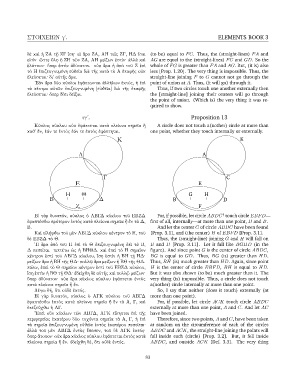
               Κύκλος κύκλου οὐκ ἐφάπτεται κατὰ πλείονα σημεῖα ἢ   A circle does not touch a(nother) circle at more than
            καθ᾿ ἕν, ἐάν τε ἐντὸς ἐάν τε ἐκτὸς ἐφάπτηται.       one point, whether they touch internally or externally.
                                                  Κ                                                  K


                                  Α                                                   A


                                            Γ                                                   C
                                 Ε                                                  E

                            Η      Θ                                            G     H
                      Β                    ∆                             B                    D
                                 Ζ                                                  F

                                                                                              †
               Εἰ γὰρ δυνατόν, κύκλος ὁ ΑΒΓΔ κύκλου τοῦ ΕΒΖΔ       For, if possible, let circle ABDC touch circle EBFD—
            ἐφαπτέσθω πρότερον ἐντὸς κατὰ πλείονα σημεῖα ἢ ἓν τὰ Δ, first of all, internally—at more than one point, D and B.
            Β.                                                     And let the center G of circle ABDC have been found
               Καὶ εἰλήφθω τοῦ μὲν ΑΒΓΔ κύκλου κέντρον τὸ Η, τοῦ [Prop. 3.1], and (the center) H of EBFD [Prop. 3.1].
            δὲ ΕΒΖΔ τὸ Θ.                                          Thus, the (straight-line) joining G and H will fall on
               ῾Η ἄρα ἀπὸ τοῦ Η ἐπὶ τὸ Θ ἐπιζευγνυμένη ἐπὶ τὰ Β, B and D [Prop. 3.11]. Let it fall like BGHD (in the
            Δ πεσεῖται. πιπτέτω ὡς ἡ ΒΗΘΔ. καὶ ἐπεὶ τὸ Η σημεῖον figure). And since point G is the center of circle ABDC,
            κέντρον ἐστὶ τοῦ ΑΒΓΔ κύκλου, ἴση ἐστὶν ἡ ΒΗ τῇ ΗΔ·  BG is equal to GD. Thus, BG (is) greater than HD.
            μείζων ἄρα ἡ ΒΗ τῆς ΘΔ· πολλῷ ἄρα μείζων ἡ ΒΘ τῆς ΘΔ. Thus, BH (is) much greater than HD. Again, since point
            πάλιν, ἐπεὶ τὸ Θ σημεῖον κέντρον ἐστὶ τοῦ ΕΒΖΔ κύκλου, H is the center of circle EBFD, BH is equal to HD.
            ἴση ἐστὶν ἡ ΒΘ τῇ ΘΔ· ἐδείχθη δὲ αὐτῆς καὶ πολλῷ μείζων· But it was also shown (to be) much greater than it. The
            ὅπερ ἀδύνατον· οὐκ ἄρα κύκλος κύκλου ἐφάπτεται ἐντὸς  very thing (is) impossible. Thus, a circle does not touch
            κατὰ πλείονα σημεῖα ἢ ἕν.                           a(nother) circle internally at more than one point.
               Λέγω δή, ὅτι οὐδὲ ἐκτός.                            So, I say that neither (does it touch) externally (at
               Εἰ γὰρ δυνατόν, κύκλος ὁ ΑΓΚ κύκλου τοῦ ΑΒΓΔ more than one point).
            ἐφαπτέσθω ἐκτὸς κατὰ πλείονα σημεῖα ἢ ἓν τὰ Α, Γ, καὶ  For, if possible, let circle ACK touch circle ABDC
            ἐπεζεύχθω ἡ ΑΓ.                                     externally at more than one point, A and C. And let AC
               ῎Επεὶ οὖν κύκλων τῶν ΑΒΓΔ, ΑΓΚ εἴληπται ἐπὶ τῆς have been joined.
            περιφερείας ἑκατέρου δύο τυχόντα σημεῖα τὰ Α, Γ, ἡ ἐπὶ  Therefore, since two points, A and C, have been taken
            τὰ σημεῖα ἐπιζευγνυμένη εὐθεῖα ἐντὸς ἑκατέρου πεσεῖται· at random on the circumference of each of the circles
            ἀλλὰ τοῦ μὲν ΑΒΓΔ ἐντὸς ἔπεσεν, τοῦ δὲ ΑΓΚ ἐκτός· ABDC and ACK, the straight-line joining the points will
            ὅπερ ἄτοπον· οὐκ ἄρα κύκλος κύκλου ἐφάπτεται ἐκτὸς κατὰ fall inside each (circle) [Prop. 3.2]. But, it fell inside
            πλείονα σημεῖα ἢ ἕν. ἐδείχθη δέ, ὅτι οὐδὲ ἐντός.    ABDC, and outside ACK [Def. 3.3]. The very thing


                                                              83

