


Page 86 - Euclid's Elements of Geometry
P. 86
ST	EW      gþ.


                                                                                            ELEMENTS BOOK 3


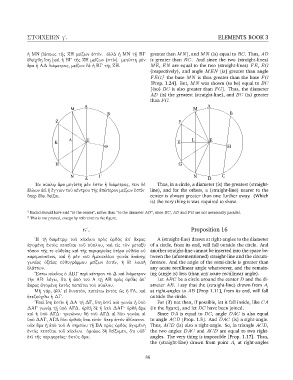
            ἡ ΜΝ βάσεως τῆς ΖΗ μείζων ἐστίν. ἀλλὰ ἡ ΜΝ τῇ ΒΓ    greater than MN], and MN (is) equal to BC. Thus, AD
            ἐδείχθη ἴση [καὶ ἡ ΒΓ τῆς ΖΗ μείζων ἐστίν]. μεγίστη μὲν is greater than BC. And since the two (straight-lines)
            ἄρα ἡ ΑΔ διάμετρος, μείζων δὲ ἡ ΒΓ τῆς ΖΗ.          ME, EN are equal to the two (straight-lines) FE, EG
                                                                (respectively), and angle MEN [is] greater than angle
                                                                     ‡
                                                                FEG, the base MN is thus greater than the base FG
                                                                [Prop. 1.24]. But, MN was shown (to be) equal to BC
                                                                [(so) BC is also greater than FG]. Thus, the diameter
                                                                AD (is) the greatest (straight-line), and BC (is) greater
                                                                than FG.
                                    Α                                                   A
                               Μ                                                  M
                                              Β                                                  B
                        Ζ                                                   F


                              Λ      Ε                                           L       E
                        Κ                                                  K
                                             Θ                                                  H


                        Η                                                   G

                                    iþ                         is) the very thing it was required to show.
                               Ν     ∆    Γ                                       N     D     C
               ᾿Εν κύκλῳ ἄρα μεγίστη μὲν έστιν ἡ διάμετρος, τῶν δὲ  Thus, in a circle, a diameter (is) the greatest (straight-
            ἄλλων ἀεὶ ἡ ἔγγιον τοῦ κέντρου τῆς ἀπώτερον μείζων ἐστίν· line), and for the others, a (straight-line) nearer to the
            ὅπερ ἔδει δεῖξαι.                                   center is always greater than one further away. (Which


            †  Euclid should have said “to the center”, rather than ”to the diameter AD”, since BC, AD and F G are not necessarily parallel.
            ‡  This is not proved, except by reference to the figure.

                                                                                 Proposition 16
                                      .
               ῾Η τῇ διαμέτρῳ τοῦ κύκλου πρὸς ὀρθὰς ἀπ᾿ ἄκρας      A (straight-line) drawn at right-angles to the diameter
            ἀγομένη ἐκτὸς πεσεῖται τοῦ κύκλου, καὶ εἰς τὸν μεταξὺ of a circle, from its end, will fall outside the circle. And
            τόπον τῆς τε εὐθείας καὶ τῆς περιφερείας ἑτέρα εὐθεῖα οὐ another straight-line cannot be inserted into the space be-
            παρεμπεσεῖται, καὶ ἡ μὲν τοῦ ἡμικυκλίου γωνία ἁπάσης tween the (aforementioned) straight-line and the circum-
            γωνίας ὀξείας εὐθυγράμμου μείζων ἐστίν, ἡ δὲ λοιπὴ ference. And the angle of the semi-circle is greater than
            ἐλάττων.                                            any acute rectilinear angle whatsoever, and the remain-
               ῎Εστω κύκλος ὁ ΑΒΓ περὶ κέντρον τὸ Δ καὶ διάμετρον ing (angle is) less (than any acute rectilinear angle).
            τὴν ΑΒ· λέγω, ὅτι ἡ ἀπὸ τοῦ Α τῇ ΑΒ πρὸς ὀρθὰς ἀπ᾿     Let ABC be a circle around the center D and the di-
            ἄκρας ἀγομένη ἐκτὸς πεσεῖται τοῦ κύκλου.            ameter AB. I say that the (straight-line) drawn from A,
               Μὴ γάρ, ἀλλ᾿ εἰ δυνατόν, πιπτέτω ἐντὸς ὡς ἡ ΓΑ, καὶ at right-angles to AB [Prop 1.11], from its end, will fall
            ἐπεζεύχθω ἡ ΔΓ.                                     outside the circle.
               ᾿Επεὶ ἴση ἐστὶν ἡ ΔΑ τῇ ΔΓ, ἴση ἐστὶ καὶ γωνία ἡ ὑπὸ  For (if) not then, if possible, let it fall inside, like CA
            ΔΑΓ γωνίᾳ τῇ ὑπὸ ΑΓΔ. ὀρθὴ δὲ ἡ ὑπὸ ΔΑΓ· ὀρθὴ ἄρα (in the figure), and let DC have been joined.
            καὶ ἡ ὑπὸ ΑΓΔ· τριγώνου δὴ τοῦ ΑΓΔ αἱ δύο γωνίαι αἱ    Since DA is equal to DC, angle DAC is also equal
            ὑπὸ ΔΑΓ, ΑΓΔ δύο ὀρθαῖς ἴσαι εἰσίν· ὅπερ ἐστὶν ἀδύνατον. to angle ACD [Prop. 1.5]. And DAC (is) a right-angle.
            οὐκ ἄρα ἡ ἀπὸ τοῦ Α σημείου τῇ ΒΑ πρὸς ὀρθὰς ἀγομένη Thus, ACD (is) also a right-angle. So, in triangle ACD,
            ἐντὸς πεσεῖται τοῦ κύκλου. ὁμοίως δὴ δεῖξομεν, ὅτι οὐδ᾿ the two angles DAC and ACD are equal to two right-
            ἐπὶ τῆς περιφερείας· ἐκτὸς ἄρα.                     angles. The very thing is impossible [Prop. 1.17]. Thus,
                                                                the (straight-line) drawn from point A, at right-angles

                                                              86

