


Page 90 - Euclid's Elements of Geometry
P. 90
ST	EW      gþ.


                                                                                            ELEMENTS BOOK 3


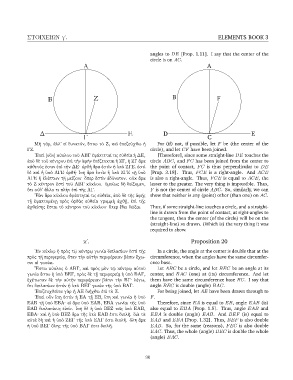
                                                                angles to DE [Prop. 1.11]. I say that the center of the
                                                                circle is on AC.
                                    Α                                                   A


                     Β                  Ζ                                B                  F


                  ∆                                   Ε              D                                    E
                                    Γ                                                   C
               Μὴ γάρ, ἀλλ᾿ εἰ δυνατόν, ἔστω τὸ Ζ, καὶ ἐπεζεύχθω ἡ  For (if) not, if possible, let F be (the center of the
            ΓΖ.                                                 circle), and let CF have been joined.
               ᾿Επεὶ [οὖν] κύκλου τοῦ ΑΒΓ ἐφάπτεταί τις εὐθεῖα ἡ ΔΕ,  [Therefore], since some straight-line DE touches the
            ἀπὸ δὲ τοῦ κέντρου ἐπὶ τὴν ἁφὴν ἐπέζευκται ἡ ΖΓ, ἡ ΖΓ ἄρα circle ABC, and FC has been joined from the center to
            κάθετός ἐστιν ἐπὶ τὴν ΔΕ· ὀρθὴ ἄρα ἐστὶν ἡ ὑπὸ ΖΓΕ. ἐστὶ  the point of contact, FC is thus perpendicular to DE
            δὲ καὶ ἡ ὑπὸ ΑΓΕ ὀρθή· ἴση ἄρα ἐστὶν ἡ ὑπὸ ΖΓΕ τῇ ὑπὸ [Prop. 3.18]. Thus, FCE is a right-angle. And ACE
            ΑΓΕ ἡ ἐλάττων τῇ μείζονι· ὅπερ ἐστὶν ἀδύνατον. οὐκ ἄρα is also a right-angle. Thus, FCE is equal to ACE, the
            τὸ Ζ κέντρον ἐστὶ τοῦ ΑΒΓ κύκλου. ὁμοίως δὴ δείξομεν, lesser to the greater. The very thing is impossible. Thus,
                                    kþ                          line is drawn from the point of contact, at right-angles to
            ὅτι οὐδ᾿ ἄλλο τι πλὴν ἐπὶ τῆς ΑΓ.                   F is not the center of circle ABC. So, similarly, we can
               ᾿Εὰν ἄρα κύκλου ἐφάπτηταί τις εὐθεῖα, ἀπὸ δὲ τῆς ἁφῆς show that neither is any (point) other (than one) on AC.
            τῇ ἐφαπτομένῃ πρὸς ὀρθὰς εὐθεῖα γραμμὴ ἀχθῇ, ἐπὶ τῆς
            ἀχθείσης ἔσται τὸ κέντρον τοῦ κύκλου· ὅπερ ἔδει δεῖξαι.  Thus, if some straight-line touches a circle, and a straight-

                                                                the tangent, then the center (of the circle) will be on the
                                                                (straight-line) so drawn. (Which is) the very thing it was
                                                                required to show.

                                                                                 Proposition 20
                                      .
               ᾿Εν κύκλῳ ἡ πρὸς τῷ κέντρῳ γωνία διπλασίων ἐστὶ τῆς  In a circle, the angle at the center is double that at the
            πρὸς τῇ περιφερείᾳ, ὅταν τὴν αὐτὴν περιφέρειαν βάσιν ἔχω-  circumference, when the angles have the same circumfer-
            σιν αἱ γωνίαι.                                      ence base.
               ῎Εστω κύκλος ὁ ΑΒΓ, καὶ πρὸς μὲν τῷ κέντρῳ αὐτοῦ    Let ABC be a circle, and let BEC be an angle at its
            γωνία ἔστω ἡ ὑπὸ ΒΕΓ, πρὸς δὲ τῇ περιφερείᾳ ἡ ὑπὸ ΒΑΓ, center, and BAC (one) at (its) circumference. And let
            ἐχέτωσαν δὲ τὴν αὐτὴν περιφέρειαν βάσιν τὴν ΒΓ· λέγω, them have the same circumference base BC. I say that
            ὅτι διπλασίων ἐστὶν ἡ ὑπὸ ΒΕΓ γωνία τῆς ὑπὸ ΒΑΓ.    angle BEC is double (angle) BAC.
               ᾿Επιζευχθεῖσα γὰρ ἡ ΑΕ διήχθω ἐπὶ τὸ Ζ.             For being joined, let AE have been drawn through to
               ᾿Επεὶ οὖν ἴση ἐστὶν ἡ ΕΑ τῇ ΕΒ, ἴση καὶ γωνία ἡ ὑπὸ F.
            ΕΑΒ τῇ ὑπὸ ΕΒΑ· αἱ ἄρα ὑπὸ ΕΑΒ, ΕΒΑ γωνίαι τῆς ὑπὸ     Therefore, since EA is equal to EB, angle EAB (is)
            ΕΑΒ διπλασίους εἰσίν. ἴση δὲ ἡ ὑπὸ ΒΕΖ ταῖς ὑπὸ ΕΑΒ,  also equal to EBA [Prop. 1.5]. Thus, angle EAB and
            ΕΒΑ· καὶ ἡ ὑπὸ ΒΕΖ ἄρα τῆς ὑπὸ ΕΑΒ ἐστι διπλῆ. διὰ τὰ  EBA is double (angle) EAB. And BEF (is) equal to
            αὐτὰ δὴ καὶ ἡ ὑπὸ ΖΕΓ τῆς ὑπὸ ΕΑΓ ἐστι διπλῆ. ὅλη ἄρα EAB and EBA [Prop. 1.32]. Thus, BEF is also double
            ἡ ὑπὸ ΒΕΓ ὅλης τῆς ὑπὸ ΒΑΓ ἐστι διπλῆ.              EAB. So, for the same (reasons), FEC is also double
                                                                EAC. Thus, the whole (angle) BEC is double the whole
                                                                (angle) BAC.


                                                              90

