


Page 13 - ...........
P. 13
e.    It develops  the immune  system to protect from  disease  and
                  infection by producing antibodies.

            f.    It helps the reproductive process by producing sex hormones.
            Activity 1.1

            Divide the students into two groups. Prepare eight cut-outs (pieces) of
            a chart paper in each group.  Write the names of endocrine glands on
            the cutouts by the first group. Similarly, write the functions of these
            glands on the cutouts by the second group. Show the name of a gland
            by the first group and show the functions of the relative gland by the
            second group. Similarly show the functions of a gland by the second
            group and show the name of the relative gland by the first group.


            1.3 Reproductive System

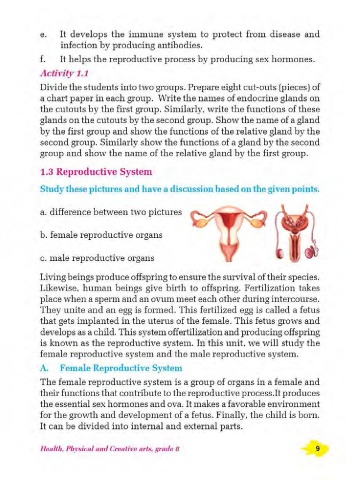
            Study these pictures and have a discussion based on the given points.


            a. difference between two pictures


            b. female reproductive organs


            c. male reproductive organs

            Living beings produce offspring to ensure the survival of their species.
            Likewise,  human beings give  birth to offspring. Fertilization takes
            place when a sperm and an ovum meet each other during intercourse.
            They unite and an egg is formed. This fertilized egg is called a fetus
            that gets implanted in the uterus of the female. This fetus grows and
            develops as a child. This system offertilization and producing offspring
            is known as the reproductive syste1n. In this unit, we will study the
            female reproductive system and the male reproductive system.

            A.    Fen1ale Reproductive Syste111
            The female reproductive system is a group of organs in a female and
            their functions that contribute to the reproductive process.It produces
            the essential sex honnones and ova. It nlakes a favorable environment
            for the growth and development of a fetus. Finally, the child is born.
            It can be divided into internal and external parts.


            llanllh, Pbysit:nl and Crnnliva arl.<i, grndu 8                                9

