


Page 15 - ...........
P. 15
2. Uterus

            Uterus is a hollow, pear-shaped muscular organ. It helps to nourish
            and house a fetus until the fetus is ready to be delivered. It is also
            known as a womb. It is about 7.5  cm long and 5  cm wide.  Its wall
            thickness is 2.5 cm on average. The average weight is 60 grams in an
            adult woman. However, its weight and size increase during pregnancy
            due to the growth of the fetus. The pelvic floor muscles are supporting
            it. If the pelvic floor nluscles become weak due to injury and even
            the  normal aging process, the uterus  can move  downwards  from
            its  nonnal position.  This  condition is  known as  uterine prolapse.
            Teenage pregnancy and difficult labour can cause this problem. The
            Government of Nepal is treating this proble111 free of cost.

            3. Fallopian Tube

            Fallopian tubes are the nanow tubes that are attached to the upper
            part of the uterus. They are 10 to  12 cm long and about 3  cm wide.
            They  serve as pathways for  the ovum to travel from the ovaries to
            the uterus. Fertilization normally occurs in the fallopian tubes. The
            fertilized  egg then moves to the uterus,  where it implants into  the
            uterine lining.

            4. Ovary

            Ovaries are small, oval-shaped glands that are located on either side of
            the uterus. They are about 2.5 cm long, 1.5 cm wide and 1 cm thick.
            It weighs 8 to 10 gram.  The ovaries produce eggs and hormones. An
            ovary releases an egg each month. This process of producing egg is
            called ovulation.

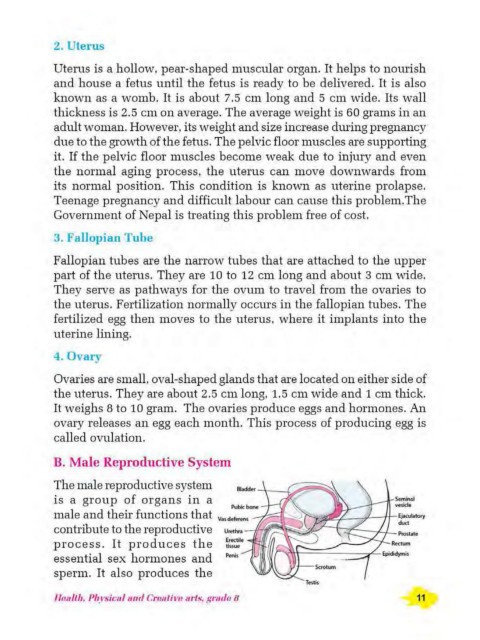
            B. Male Reproductive Syste1n

            The male reproductive system
            is  a  group  of  organs  in  a
                   ..._,          ..._,           Pubic~
                                                         •
            male and their functions that  vasdeterens  ~ ..---,                      E;aeui.iory
                                                                                      duct
            contribute to the reproductive  ure1hra -li'tM~~~~\-:::r:::._--1.'-L_ Prostate
            process.  It produces  t h e         ~~~ie
            essential sex hormones and           Penis
            sperm.  It also  produces  the

            llanllh, Pbysit:nl and Crnnliva arl.<i, grndu 8                               11

