


Page 8 - ...........
P. 8
b. Spinal Cord

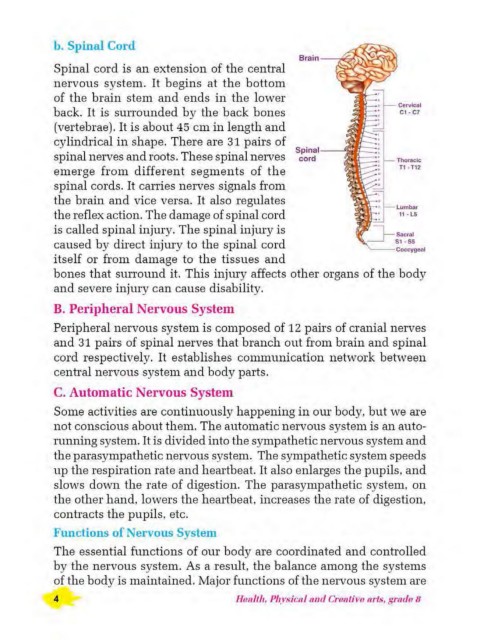
            Spinal cord is an extension of the central
            nervous system.  It begins  at the bottom
            of the brain stem and ends in the lower
            back.  It is  surrounded by  the back bones
            (vertebrae). It is about 45 cm in length and
            cylindrical in shape. There are 31 pairs of
                                                                Spinal-~-===
            spinal nerves and roots. These spinal nerves         cord                Thoracic
            emerge  from  different  segments  of the                                 T1  · T12
            spinal cords. It carries nerves signals from
            the brain and vice versa. It also regulates
            the reflex action. The damage of spinal cord
            is called spinal injury. The spinal injury is
            caused by direct injury to the spinal cord
                                                                                     Coccygeal
            itself or from  damage to  the  tissues  and
            bones that surround it. This injury affects other organs of the body
            and severe injury can cause disability.
            B. Peripheral Nervous System

            Peripheral nervous system is composed of 12 pairs of cranial nerves
            and 31 pairs of spinal nerves that branch out from brain and spinal
            cord respectively.  It establishes  communication network between
            central nervous system and body parts.

            C. Automatic Nervous System
            Some activities are continuously happening in our body, but we are
            not conscious about them. The auto1natic nervous system is an auto-
            running system. It is divided into the sympathetic nervous system and
            the parasympathetic nervous system. The sympathetic system speeds
            up the respiration rate and heartbeat. It also enlarges the pupils, and
            slows down the rate of digestion. The parasympathetic systen1, on
            the other hand, lowers the heartbeat, increases the rate of digestion,
            contracts the pupils, etc.
            Functions of Nervous Syste1n

            The essential functions of our body are coordinated and controlled
            by the nervous system. As a result, the balance among the systems
            of the body is maintained. Major functions of the nervous system are
            4                                      Health, Physical ai1d Creillive arts, grade 8

