


Page 207 - ...........
P. 207
Samhala.This  Taal  also  falls  under the  group  of KhyaliTaal.  The
            8  beats  of this  Taal  are  also  divided  into  2  divisions  of  4  beats
            each.  Although Khyali,  Samhala, and Selo have the saine number
            of beats, they differ from each other due to their different playing
            styles.  Damphu is  an instrument played on the  Selo.  It  is  widely
            used  in  folk  and  traditional  songs  such  as  Tamang  Selo  of  the
            Tamang  tribe  andShebru  of  the  Sherpa  tribe.  Son1e  examples
            of songs  using  Selo  Taal  are:  KalkatteKaiyo  Kesh  Mero  Bangyo,
            HimalJhalalaHiuleMaichyangRamriJiule, Chyangwa Hoi Chyangwa,
            Lekaka Hami Keta Keti, MathiMathiSailungema, etc.

                                                   I ~


            12 .8  Practising playing local folk instruments-melodic and percussive

            Local folk instruments are 1nade using locally available means and
            materials.They  reflect the  characteristics  of a  particular locality,
            community,  or ethnicity.  They  are  used to  producemusical notes
            or sounds.Folk instruments are mostly used in local and folk songs.
            There are many folk instruments that are often used in Nepali music.
            We'll learn about a few instruments in this class.

            (a) Sarangi (Introduction to Sarangi)

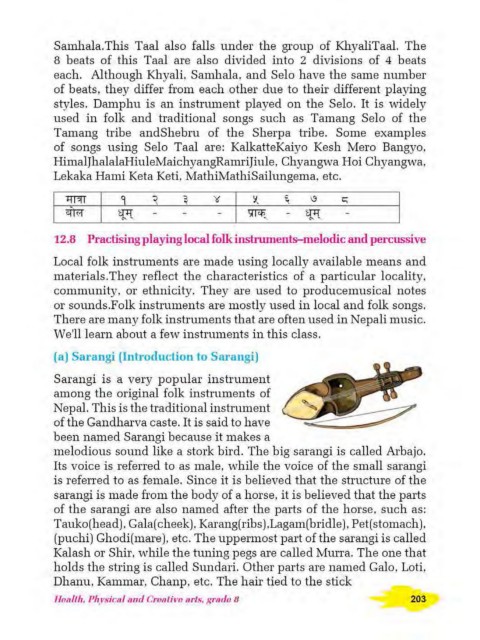
            Sarangi is  a  very  popular instru1nent
            among the original folk  instruments of
            Nepal. This is the traditional instrument
            of the Gandharva caste. It is said to have
            been named Sarangi because it makes a
            1nelodious sound like a stork bird. The big sarangi is called Arbajo.
            Its voice is referred to as male,  while the voice of the small sarangi
            is referred to as female.  Since it is believed that the structure of the
            sarangi is made from the body of a horse, it is believed that the parts
            of the sarangi are also named after the parts of the horse, such as:
            Tauko(head), Gala( cheek), Karang( ribs) ,Lagam(bridle), Pet( stomach),
            (puchi) Ghodi(mare ), etc. The uppermost part of the sarangi is called
            Kalash or Shir, while the tuning pegs are called Murra. The one that
            holds the string is called Sundari. Other parts are named Galo, Loti,
            Dhanu, Kammar, Chanp, etc. The hair tied to the stick
            Tlon/Lh, Physicnl and Crrmlivo arl.'>, grnrln 0                             203

