


Page 210 - ...........
P. 210
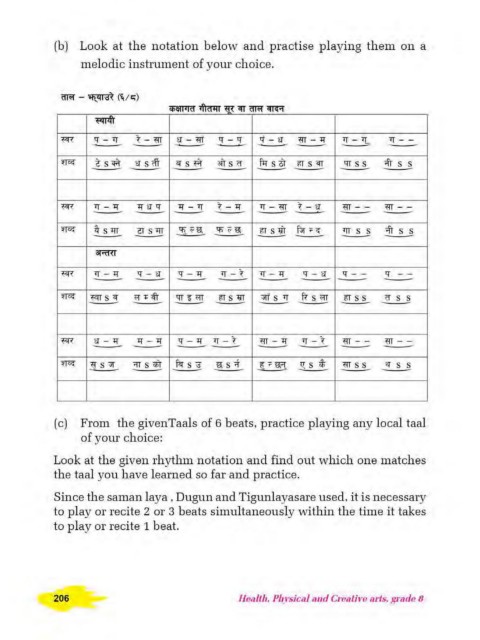
(b)  Look  at  the notation below and practise playing them on a

                  melodic instrument of your choice.


                                     q;-~        m-qr~~
                     ~

                                      - -- -
              ~  11  - 1T  z- m  u -m          q"-q'    q'  - u  m - ll"   -        -
                             -
                     -
                                                                -
                                                                                    1T  - -
                                                                          1T  - 1l.
                    -        --                -- -             -        ~
                                                                                  --
              ~l'CG   ls <R   u s <ft   ~               Pr sir  ITT  S err         ;fr  s  s
                                               3fr s (f
                     -        -       -        -        - -              -        -
              ~  lT-ll"       ll" u q   ll"-lT   Z -ll"   <r  - m  z-u    m- -     m- -
                     -- --                     -- -- -- -- -
              ~l'CG   ft s m   CT  S +IT   _i.:is  <-~_   q; <- ~   ITT  Sm  f,;f  ;: ~   m  s  s   ;fr  s  s
                     3RRf
                     -        -       -        -        -        - -               -
              ~  ll -ll"      11 - U   q'-ll"   1T  - {   ll-11"   11- U   11--    q  -  -

                    -        -- -              --       ~ ~ l!E.-                 -
              ~l'CG   ~s cr   ~fl= <fr   qr~ m   ITT S lJT                         (f  s  s


                     -       -- -- -                             -       -        -
              ~  u - 11"      11"  - 11"   11  - 11"   1T  - {   m - 11"   1T  - ~   m- -  m- -

                                                                                  -
                                                                                   ~ s  s
              ~l'CG   "«  s 'if   ~ ~ ~ ~                                ~
                                                                 ~ s  if;


            (c)  From  the givenTaals of 6 beats, practice playing any local taal
                  of your choice:
            Look at the given rhythm notation and find out which one matches
            the taal you have learned so far and practice.

            Since the saman la ya , Dugun and Tigunlayasare used, it is necessary
            to play or recite 2 or 3 beats sin1ultaneously within the time it takes
            to play or recite 1 beat.


            206                                     Ilealth. Physical m1d l.J.·eative m·ts. grnde 8

