


Page 216 - ...........
P. 216
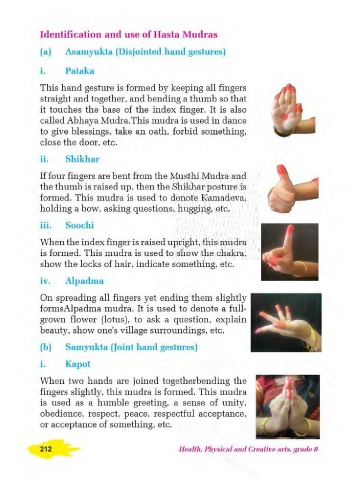
Identification and use of Hasta Mudras
            (a)    Asamyukta (Disjointed hand gestures)


            i.      Pataka

            This hand gesture is formed by keeping all fingers
            straight and together, and bending a thumb so that
            it touches the base  of the  index finger.  It is  also
            called Abhaya Mudra. This mudra is used in dance
            to give blessings, take an oath, forbid something,
            close the door, etc.


            ii.     Shikhar

            If four fingers are bent from the Musthi Mudra and
            the thumb is raised up, then the Shikhar posture is
            formed.  This mudra is used to denote Kamadeva,
            holding a bow, asking questions, hugging, etc.

            iii.    Soochi

            When the index finger is raised upright, this mudra
            is formed. This nn1dra is used to show the chakra,
            show the locks of hair, indicate something, etc.

            iv.    Alpadma

            On spreading all fingers  yet ending then1 slightly
            formsAlpadma mudra. It is used to denote a full-
            grown  flower  (lotus),  to  ask  a  question,  explain
            beauty,  show one's village surroundings, etc.

            (b)     Samyukta (Joint hand gestures)

            i.     Ka pot

            When two  hands are  joined togetherbending the
            fingers slightly, this mudra is formed. This mudra
            is  used  as  a  hun1ble  greeting,  a  sense  of unity,
            obedience,  respect,  peace, respectful acceptance,
            or acceptance of something, etc.


            212                                     Ilealth. Physical m1d l.J.·eative m·ts. grnde 8

