


Page 220 - ...........
P. 220
( c) Introduction to Selo dance
            The Selo dance is the identity of the Tamang people. A111ong many
            ethnic groups in Nepal, the Tamang people have their own traditional
            language,  religion,  customs,  and  culture,  establishing a  distinct
            identity. Among these traditions and cultures, Selo is a very im.portant
            cultural dance of the traditional Tamang society.

            Tamang Selo  is  a  short and cheerful song  sung in the  rhythm of
            Damphu. Both Damphu and Selo are complementary to each other.
            Selo  without Damphu  and Damphu without Seloare  like  poetry
            without Rasa.  During various  festivals  and occasions  like Sonam
            Lhosarand Buddha Poornima, Tamang people perform the Selo dance
            to the rhythm of Damphu.

            Activity  13. 8

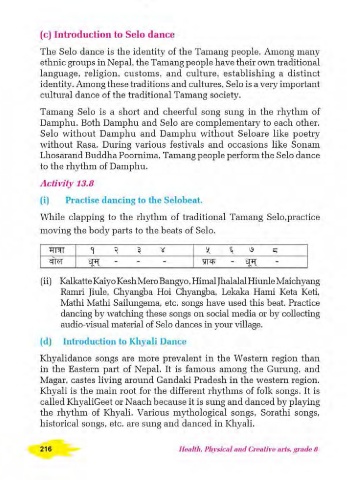
            (i)     Practise dancing to the Seloheat.

            While  clapping to  the rhythm of traditional  Tamang Selo,practice
            moving the body parts to the beats of Selo.


                                                       I ;,.


            (ii)  Kalkatte Kai yo Kesh Mero Bangyo, Himal Jhalalal Hiunle Maichyang
                  Ramri  Jiule,  Chyangba  Hoi  Chyangba,  Lekaka  Hami  Keta  Keti,
                  Mathi Mathi Sailungema, etc. songs have used this beat. Practice
                  dancing by watching these songs on social media or by collecting
                  audio-visual material of Selo dances in your village.

            ( d)   Introduction to Khyali Dance

            Khyalidance songs  are inore prevalent in the Western region than
            in the Eastern part of Nepal.  It is famous  among the Gurung, and
            Magar, castes living around Gandaki Pradesh in the western region.
            Khyali is the main root for the different rhythms of folk songs. It is
            called KhyaliGeet or Naach because it is sung and danced by playing
            the  rhythm of Khyali.  Various mythological  songs,  Sorathi  songs,
            historical songs, etc. are sung and danced in Khyali.


            216                                     Ilealth. Physical m1d l.J.·eative m·ts. grnde 8

