


Page 6 - ...........
P. 6
1.1 Nervous System

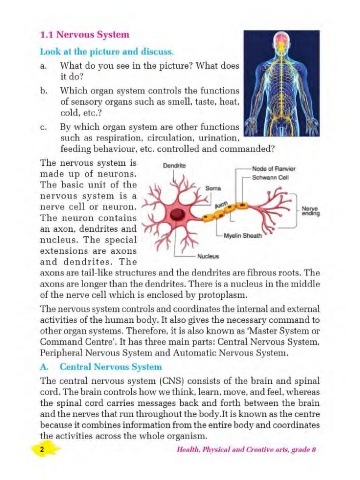
            Look at the picture and discuss.
            a.    What do you see in the picture? What does
                  it do?
            b.    Which organ system controls the functions
                  of sensory organs such as smell, taste, heat,
                  cold, etc.?

            c.    By which organ system are other functions
                  such as  respiration,  circulation, urination,
                  feeding behaviour, etc. controlled and commanded?
            The nervous system is              Dendrlte
                                                                         Node cl RSIWier
            n1ade  up  of  neurons.                                     Schwann Cell
            The  basic  unit  of the
            nervous  system  is  a
            nerve  cell  or  neuron.
            The  neuron  contains
            an axon, dendrites and
            nucleus.  The  special
            extensions  are  axons
            and  dendrites.  The
            axons are tail-like structures and the dendrites are fibrous roots. The
            axons are longer than the dendrites. There is a nucleus in the middle
            of the nerve cell which is enclosed by protoplasm.
            The nervous system controls and coordinates the internal and external
            activities of the human body. It also gives the necessary command to
            other organ systems. Therefore, it is also known as 'Master Syste1n or
            Coilllnand Centre'. It has three main parts: Central Nervous System,
            Peripheral Nervous System and Automatic Nervous System.
            A.    Central Nervous Systen1

            The central nervous system (CNS)  consists of the brain and spinal
            cord. The brain controls how we think, learn, move, and feel, whereas
            the spinal cord carries messages back and forth between the brain
            and the nerves that run throughout the body.It is known as the centre
            because it combines information from the entire body and coordinates
            the activities across the whole organis1n.
            2                                      Health, Physical ai1d Creillive arts, grade 8

