


Page 7 - ...........
P. 7
a. Brain
            The brain is housed inside
            the  skull.  The  average
            weight  of the brain of an -r-

            adult is 1.5 kg. It is made up        ,,,__
            of soft tissue. It is protected
            by the  thin  layer  of the
            membrane which is known
            as the meninges.
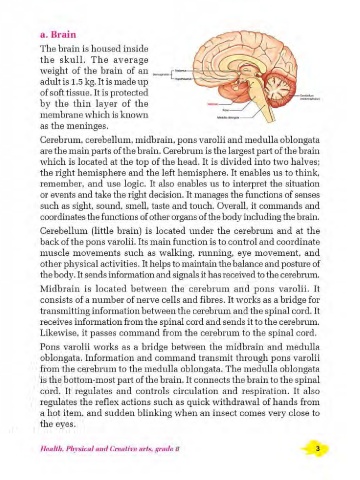
            Cerebrum, cerebellum, midbrain, pons varolii and medulla oblongata
            are the main parts of the brain. Cerebrum is the largest part of the brain
            which is located at the top of the head. It is divided into two halves;
            the right hemisphere and the left hemisphere. It enables us to think,
            remember,  and use logic.  It also enables us to interpret the situation
            or events and take the right decision. It manages the functions of senses
            such as sight, sound, smell, taste and touch. Overall, it commands and
            coordinates the functions of other organs of the body including the brain.
            Cerebellum (little brain)  is located under the  cerebrum and at the
            back of the pons varolii. Its main function is to control and coordinate
            muscle inovements such as  walking, running, eye movement, and
            other physical activities. It helps to maintain the balance and posture of
            the body. It sends information and signals it has received to the cerebrum.

            Midbrain is located between  the  cerebrum and pons  varolii.  It
            consists of a nu1nber of nerve cells and fibres. It works as a bridge for
            transmitting information between the cerebrum and the spinal cord. It
            receives information from the spinal cord and sends it to the cerebrum.
            Likewise, it passes com111and from the cerebrum to the spinal cord.

            Pons varolii works as a bridge between the midbrain and medulla
            oblongata. Infonnation and command transmit through pons varolii
            from the cerebrum to the medulla oblongata. The medulla oblongata
            is the bottom-most part of the brain. It connects the brain to the spinal
            cord.  It regulates  and controls  circulation and respiration. It also
            regulates the reflex actions such as quick withdrawal of hands from
            a hot item, and sudden blinking when an insect comes very close to
            the eyes.


            llanllh, Pbysit:nl and Crnnliva nrl.<i, grndu 8                                3

