


Page 173 - digitalliteracy
P. 173
8.2 Writing an Effective Cover Letter


                   First and foremost, you need to portray
                   yourself as a professional. Your cover
                   letter is a business letter that uses for-
                   mal language and should be formatted
                   with the basic elements of such a let-
                   ter: a date, a mailing address, a saluta-
                   tion such as “Dear Mr. Moran,” three or
                   four paragraphs of text, a complimen-
                   tary close such as “Sincerely,” and your
                   signature and typed name at the bot-
                   tom. Whether you submit your résumé
                   by mail, e-mail, or online, you should
                   include a well-written cover  letter
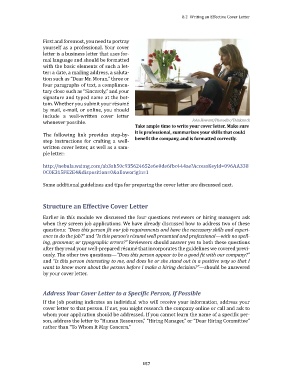
                                                                                 John Howard/Photodisc/Thinkstock
                   whenever possible.
                                                         Take ample time to write your cover letter. Make sure
                                                         it is professional, summarizes your skills that could
                   The following  link  provides  step-by-  benefit the company, and is formatted correctly.
                   step instructions for  crafting a well-
                   written cover letter, as well as a sam-
                   ple letter:

                   http://nebula.wsimg.com/ab3ab50c935624652e6e0de6fbc444ae?AccessKeyId=096AA338
                   0C0E315FE2E4&disposition=0&alloworigin=1


                   Some additional guidelines and tips for preparing the cover letter are discussed next.


                   Structure an Effective Cover Letter


                   Earlier in this module we discussed the four questions reviewers or hiring managers ask
                   when they screen job applications. We have already discussed how to address two of these
                   questions: “Does this person fit our job requirements and have the necessary skills and experi-
                   ence to do the job?” and “Is this person’s résumé well presented and professional—with no spell-

                   ing, grammar, or typographic errors?” Reviewers should answer yes to both these questions
                   after they read your well-prepared résumé that incorporates the guidelines we covered previ-
                   ously. The other two questions—”Does this person appear to be a good fit with our company?”
                   and “Is this person interesting to me, and does he or she stand out in a positive way so that I
                   want to know more about the person before I make a hiring decision?”—should be answered
                   by your cover letter.


                   Address Your Cover Letter to a Specific Person, If Possible

                   If the job posting indicates an individual who will receive your information, address your
                   cover letter to that person. If not, you might research the company online or call and ask to
                   whom your application should be addressed. If you cannot learn the name of a specific per-
                   son, address the letter to “Human Resources,” “Hiring Manager,” or “Dear Hiring Committee”
                   rather than “To Whom It May Concern.”


                                                             157

