


Page 170 - digitalliteracy
P. 170
8.1 Building Your Résumé
rather than a Microsoft Word file. The PDF format looks the same on any computer and does
not allow others to make any changes. Strategies for Success:
Other Do’s and Don’ts for Résumé Preparation (Continued)
Different fonts take up different amounts of space on a page. To make sure your résumé fits
on one or two pages, experiment with different fonts. Regardless of which font you choose, Table 8.1: Action verbs for résumés
always make sure all text is at least 10 points in size, but no larger than 14 points, and that
accomplished coordinated helped managed recorded
headings are a little larger. If you are submitting your résumé online, remove any italics, bold,
and underlining in the formatting and any shading, graphics, and decorative lines you may achieved created implemented monitored researched
have added. Other do’s and don’ts for résumé preparation are listed in the following Strategies
adapted designed improved motivated reviewed
for Success.
administered developed increased negotiated scheduled
advised diagnosed influenced operated screened
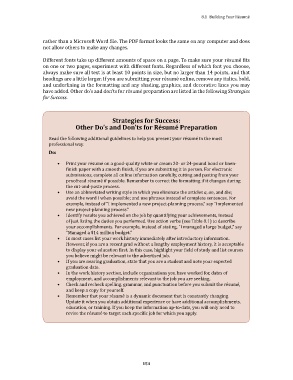
Strategies for Success: analyzed drafted informed organized streamlined
Other Do’s and Don’ts for Résumé Preparation
assessed established initiated originated supervised
Read the following additional guidelines to help you present your résumé in the most
balanced evaluated innovated performed taught
professional way.
Do: built examined invented persuaded trained
collected expanded investigated planned translated
• Print your résumé on a good-quality white or cream 20- or 24-pound bond or linen-
completed grew led prepared upgraded
finish paper with a smooth finish, if you are submitting it in person. For electronic
submissions, complete all online information carefully, cutting and pasting from your
conducted guided located produced verified
proofread résumé if possible. Remember to correct the formatting if it changes during
the cut-and-paste process. controlled handled maintained ran wrote
• Use an abbreviated writing style in which you eliminate the articles a, an, and the;
avoid the word I when possible; and use phrases instead of complete sentences. For Don’t:
example, instead of “I implemented a new project-planning process,” say “Implemented
new project-planning process.”
• Don’t put the word “Résumé” at the top.
• Identify results you achieved on the job by quantifying your achievements, instead
• Don’t provide too much information. Include only one short paragraph or four to five
of just listing the duties you performed. Use action verbs (see Table 8.1) to describe
bullet points in which you list your previous job responsibilities.
your accomplishments. For example, instead of stating, “I managed a large budget,” say
• Don’t give reasons for leaving past employment.
“Managed a $14 million budget.”
• Don’t include a photo or any attachments with your résumé.
• In most cases list your work history immediately after introductory information.
• Don’t staple the pages if your résumé is two pages in length.
However, if you are a recent grad without a lengthy employment history, it is acceptable
• Don’t list dates when you are available.
to display your education first. In this case, highlight your field of study and list courses
• Don’t state a salary request; unless the employer brings it up earlier, salary should not
you believe might be relevant to the advertised job.
be discussed until you receive a job offer.
• If you are nearing graduation, state that you are a student and note your expected
graduation date. Reflection Questions
• In the work history section, include organizations you have worked for, dates of
employment, and accomplishments relevant to the job you are seeking.
1. What other questions do you have about preparing a résumé? Ask them in the class
• Check and recheck spelling, grammar, and punctuation before you submit the résumé,
discussion forum.
and keep a copy for yourself.
2. What is the easiest and most difficult part of preparing a résumé? Why?
• Remember that your résumé is a dynamic document that is constantly changing.
3. Do you think the guidelines in this module will help you prepare or update your
Update it when you obtain additional experience or have additional accomplishments,
résumé? Why or why not?
education, or training. If you keep the information up-to-date, you will only need to
revise the résumé to target each specific job for which you apply.
154

