


Page 199 - digitalliteracy
P. 199
9.2  Credit Cards: A Tool, Not a Crutch


                       What Is Your Credit Score, and How Do You Get It?


                       Your credit score tells potential creditors your level
                       of creditworthiness. When you have an  excellent
                       credit score, lenders consider you to be financially
                       reliable  and will  offer  you better  (lower)  interest
                       rates on loans. As you now know, interest rates can
                       have a major impact on your financial future. So it
                       is vitally important to track your credit score and
                       work toward achieving an excellent rating.

                       There are four main  competing  credit  bureaus
                       (Equifax, Experian, TransUnion, and Innovis), each
                       of which gathers  information from credit issuers
                       and public records. (An alternate credit bureau is
                       described in A Closer Look: Build Credit by Paying
                       Your Bills.) Equifax, Experian, and TransUnion cre-              gpointstudio/iStock/Thinkstock
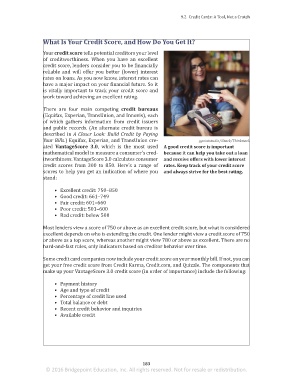
                       ated  VantageScore 3.0, which is the most used  A good credit score is important
                       mathematical model to measure a consumer’s cred-   because it can help you take out a loan
                       itworthiness. VantageScore 3.0 calculates consumer  and receive offers with lower interest
                       credit scores from 300  to 850.  Here’s a range of  rates. Keep track of your credit score
                       scores to help you get an indication of where you  and always strive for the best rating.

                       stand:

                            •  Excellent credit: 750–850
                            •  Good credit: 661–749
                            •  Fair credit: 601–660
                            •  Poor credit: 501–600
                            •  Bad credit: below 500


                       Most lenders view a score of 750 or above as an excellent credit score, but what is considered
                       excellent depends on who is extending the credit. One lender might view a credit score of 750
                       or above as a top score, whereas another might view 780 or above as excellent. There are no
                       hard-and-fast rules, only indicators based on creditor behavior over time.


                       Some credit card companies now include your credit score on your monthly bill. If not, you can
                       get your free credit score from Credit Karma, Credit.com, and Quizzle. The components that
                       make up your VantageScore 3.0 credit score (in order of importance) include the following:

                            •  Payment history
                            •  Age and type of credit
                            •  Percentage of credit line used
                            •  Total balance or debt
                            •  Recent credit behavior and inquiries
                            •  Available credit


                                                                 183
                        © 2016 Bridgepoint Education, Inc. All rights reserved. Not for resale or redistribution.


       sol82612_09_m09_171-194.indd   183                                                                            6/29/16   5:19 PM

