


Page 127 - Ultimate-Bestiary-Revenge-of-the-Horde-5E
P. 127
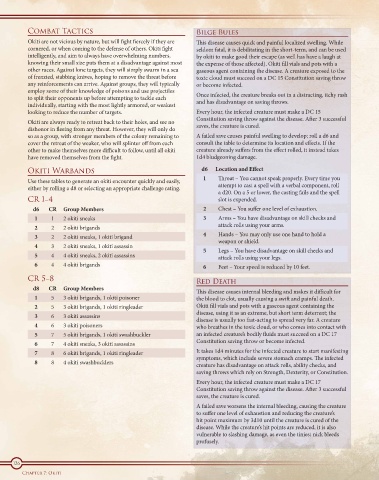
Combat Tactics                                        Bilge Bules

          Okiti are not vicious by nature, but will   ght   ercely if they are      is disease causes quick and painful localized swelling. While
          cornered, or when coming to the defense of others. Okiti   ght   seldom fatal, it is debilitating in the short-term, and can be used
          intelligently, and aim to always have overwhelming numbers,   by okiti to make good their escape (as well has have a laugh at
          knowing their small size puts them at a disadvantage against most   the expense of those a  ected). Okiti   ll vials and pots with a
          other races. Against lone targets, they will simply swarm in a sea   gaseous agent containing the disease. A creature exposed to the
          of frenzied, stabbing knives, hoping to remove the threat before   toxic cloud must succeed on a DC 15 Constitution saving throw
          any reinforcements can arrive. Against groups, they will typically   or become infected.
          employ some of their knowledge of poisons and use projectiles
          to split their opponents up before attempting to tackle each   Once infected, the creature breaks out in a distracting, itchy rash
          individually, starting with the most lightly armored, or weakest   and has disadvantage on saving throws.
          looking to reduce the number of targets.              Every hour, the infected creature must make a DC 15
          Okiti are always ready to retreat back to their holes, and see no   Constitution saving throw against the disease. A  er 3 successful
          dishonor in   eeing from any threat. However, they will only do   saves, the creature is cured.
          so as a group, with stronger members of the colony remaining to   A failed save causes painful swelling to develop; roll a d6 and
          cover the retreat of the weaker, who will splinter o   from each   consult the table to determine its location and e  ects. If the
          other to make themselves more di   cult to follow, until all okiti   creature already su  ers from the e  ect rolled, it instead takes
          have removed themselves from the   ght.               1d4 bludgeoning damage.
          Okiti Warbands                                          d6   Location and E  ect
                                                                   1       roat – You cannot speak properly. Every time you
          Use these tables to generate an okiti encounter quickly and easily,
          either by rolling a d8 or selecting an appropriate challenge rating.  attempt to cast a spell with a verbal component, roll
                                                                        a d20. On a 5 or lower, the casting fails and the spell
          CR 1–4                                                        slot is expended.
            d6   CR   Group Members                                2    Chest – You su  er one level of exhaustion.
            1     1   2 okiti sneaks                               3    Arms – You have disadvantage on skill checks and
            2     2   2 okiti brigands                                  attack rolls using your arms.
            3     2   2 okiti sneaks, 1 okiti brigand              4    Hands – You may only use one hand to hold a
                                                                        weapon or shield.
            4     3   2 okiti sneaks, 1 okiti assassin             5    Legs – You have disadvantage on skill checks and
            5     4   4 okiti sneaks, 2 okiti assassins                 attack rolls using your legs.
            6     4   4 okiti brigands                             6    Feet – Your speed is reduced by 10 feet.

          CR 5–8                                                Red Death
            d8   CR   Group Members                                is disease causes internal bleeding and makes it di   cult for
            1     5   3 okiti brigands, 1 okiti poisoner        the blood to clot, usually causing a swi   and painful death.
            2     5   3 okiti brigands, 1 okiti ringleader      Okiti   ll vials and pots with a gaseous agent containing the
            3     6   3 okiti assassins                         disease, using it as an extreme, but short term deterrent; the
                                                                disease is usually too fast-acting to spread very far. A creature
            4     6   3 okiti poisoners                         who breathes in the toxic cloud, or who comes into contact with
            5     7   5 okiti brigands, 1 okiti swashbuckler    an infected creature’s bodily   uids must succeed on a DC 17
            6     7   4 okiti sneaks, 3 okiti assassins         Constitution saving throw or become infected.
            7     8   6 okiti brigands, 1 okiti ringleader      It takes 1d4 minutes for the infected creature to start manifesting
                                                                symptoms, which include severe stomach cramps.    e infected
            8     8   4 okiti swashbucklers                     creature has disadvantage on attack rolls, ability checks, and
                                                                saving throws which rely on Strength, Dexterity, or Constitution.
                                                                Every hour, the infected creature must make a DC 17
                                                                Constitution saving throw against the disease. A  er 3 successful
                                                                saves, the creature is cured.
                                                                A failed save worsens the internal bleeding, causing the creature
                                                                to su  er one level of exhaustion and reducing the creature’s
                                                                hit point maximum by 3d10 until the creature is cured of the
                                                                disease. While the creature’s hit points are reduced, it is also
                                                                vulnerable to slashing damage, as even the tiniest nick bleeds
                                                                profusely.


     126
        Chapter 7: Okiti

