


Page 110 - ArithBook5thEd ~ BCC
P. 110
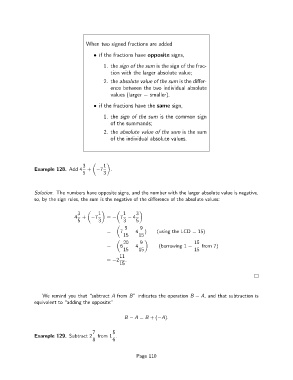
When two signed fractions are added

                                        • if the fractions have opposite signs,
                                            1. the sign of the sum is the sign of the frac-
                                               tion with the larger absolute value;
                                            2. the absolute value of the sum is the differ-
                                               ence between the two individual absolute
                                               values (larger − smaller).

                                        • if the fractions have the same sign,

                                            1. the sign of the sum is the common sign
                                               of the summands;
                                            2. the absolute value of the sum is the sum
                                               of the individual absolute values.


                                    3   "   1  #
               Example 128. Add 4 + −7         .
                                    5       3


               Solution. The numbers have opposite signs, and the number with the larger absolute value is negative,
               so, by the sign rules, the sum is the negative of the difference of the absolute values:


                                 3   "    1  #    "  1    3  #
                                4 + −7        = − 7 − 4
                                 5        3          3    5
                                                  "
                                                     5      9
                                              = − 7     − 4  )     (using the LCD = 15)
                                                     15    15
                                                     20     9                     15
                                                  "          #
                                              = − 6     − 4        (borrowing 1 =    from 7)
                                                     15    15                     15
                                                   11
                                              = −2   .
                                                   15


                   We remind you that “subtract A from B” indicates the operation B − A, and that subtraction is
               equivalent to “adding the opposite:”


                                                     B − A = B +(−A).


                                        7       5
               Example 129. Subtract 2    from 1 .
                                        8       6


                                                          Page 110

