


Page 109 - ArithBook5thEd ~ BCC
P. 109
13
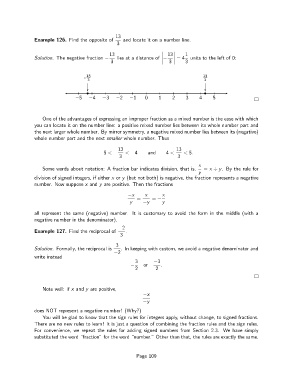
               Example 126. Find the opposite of    and locate it on a number line.
                                                  3

                                               13                   $ $ 13 $ $  1
               Solution. The negative fraction −  lies at a distance of −  $  =4  units to the left of 0:
                                                                    $
                                               3                    $   3  $  3

                                    - 13                                              13
                                      3                                               3

                                  |    |     |     |    |     |     |    |     |     |    |
                                −5    −4    −3   −2    −1     0    1     2     3    4     5


                   One of the advantages of expressing an improper fraction as a mixed number is the ease with which
               you can locate it on the number line: a positive mixed number lies between its whole number part and
               the next larger whole number. By mirror symmetry, a negative mixed number lies between its (negative)
               whole number part and the next smaller whole number. Thus

                                                  13                       13
                                           −5 < −    < −4      and    4 <     < 5.
                                                   3                       3
                                                                                    x
                   Some words about notation: A fraction bar indicates division, that is,  = x ÷ y. By the rule for
                                                                                    y
               division of signed integers, if either x or y (but not both) is negative, the fraction represents a negative
               number. Now suppose x and y are positive. Then the fractions

                                                      −x      x      x
                                                          =      = −
                                                       y     −y      y

               all represent the same (negative) number. It is customary to avoid the form in the middle (with a
               negative number in the denominator).
                                                  −2
               Example 127. Find the reciprocal of   .
                                                   3
                                                 3
               Solution. Formally, the reciprocal is  .In keeping with custom, we avoid a negative denominator and
                                                 −2
               write instead
                                                         3       −3
                                                        −    or     .
                                                         2        2


                   Note well: if x and y are positive,
                                                             −x
                                                             −y
               does NOT represent a negative number! (Why?)
                   You will be glad to know that the sign rules for integers apply, without change, to signed fractions.
               There are no new rules to learn! It is just a question of combining the fraction rules and the sign rules.
               For convenience, we repeat the rules for adding signed numbers from Section 2.3. We have simply
               substituted the word “fraction” for the word “number.” Other than that, the rules are exactly the same.


                                                          Page 109

