


Page 112 - ArithBook5thEd ~ BCC
P. 112
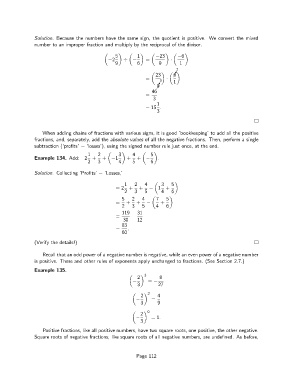
Solution. Because the numbers have the same sign, the quotient is positive. We convert the mixed
               number to an improper fraction and multiply by the reciprocal of the divisor.

                                             "     #   "    #   "     # "     #
                                                 5        1       −23      −6
                                              −2     ÷ −      =         ·
                                                 9        6        9        1
                                                                           2
                                                                          ✁✕
                                                                  23      ✁ 6
                                                                "   # " #
                                                              =     3  ·  1
                                                                   ✁ 9 ✁✕
                                                                46
                                                              =
                                                                 3
                                                                   1
                                                              =15 .
                                                                   3


                   When adding chains of fractions with various signs, it is good ‘bookkeeping’ to add all the positive
               fractions, and, separately, add the absolute values of all the negative fractions. Then, perform a single
               subtraction (‘profits’ − ‘losses’), using the signed number rule just once, at the end.
                                      1   2   "    3  #  4  "   5  #
               Example 134. Add: 2 +        + −1      +   + −      .
                                      2   3        4    5       6
               Solution. Collecting ‘Profits’ − ‘Losses,’

                                                     1   2    4  "  3    5  #
                                                 =2 +      +   − 1 +
                                                     2   3    5     4    6
                                                    5   2   4   " 7   5  #
                                                 =    +   +   −     +
                                                    2   3   5     4   6
                                                    119   31
                                                 =      −
                                                    30    12
                                                    83
                                                 =    .
                                                    60
               (Verify the details!)


                   Recall that an odd power of a negative number is negative, while an even power of a negative number
               is positive. These and other rules of exponents apply unchanged to fractions. (See Section 2.7.)

               Example 135.
                                                       "    # 3
                                                          2         8
                                                        −      = −
                                                          3        27
                                                            2      4
                                                        "    # 2
                                                          −     =
                                                            3      9
                                                            2
                                                        "    # 0
                                                          −     =1.
                                                            3
                   Positive fractions, like all positive numbers, have two square roots, one positive, the other negative.
               Square roots of negative fractions, like square roots of all negative numbers, are undefined. As before,


                                                          Page 112

