


Page 130 - ArithBook5thEd ~ BCC
P. 130
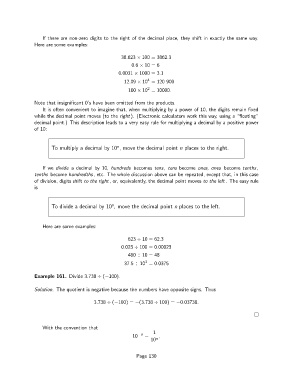
If there are non-zero digits to the right of the decimal place, theyshift inexactly the same way.
               Here are some examples:

                                                    38.623 × 100 = 3862.3
                                                        0.6 × 10 = 6
                                                   0.0031 × 1000 = 3.1
                                                               4
                                                     12.09 × 10 =120 900
                                                               2
                                                       100 × 10 =10000.
               Note that insignificant 0’s have been omitted from the products.
                   It is often convenient to imagine that, when multiplying by a power of 10, the digits remain fixed
               while the decimal point moves (to the right ). (Electronic calculators work this way, using a “floating”
               decimal point.) This description leads to a very easy rule for multiplying a decimal by a positive power
               of 10:


                                                  n
                       To multiply a decimal by 10 ,move the decimal point n places to the right.


                   If we divide adecimalby 10, hundreds becomes tens , tens become ones, ones become tenths ,
               tenths become hundredths , etc. The whole discussion above can be repeated, except that,in this case
               of division, digits shift to the right , or, equivalently, the decimal point moves to the left . The easy rule
               is


                                                n
                       To divide a decimal by 10 ,move the decimal point n places to the left.


                   Here are some examples:


                                                      623 ÷ 10 = 62.3
                                                    0.023 ÷ 100 = 0.00023
                                                      480 ÷ 10 = 48
                                                              3
                                                     37.5 ÷ 10 =0.0375
               Example 161. Divide 3.738 ÷ (−100).


               Solution. The quotient is negative because the numbers have opposite signs. Thus

                                        3.738 ÷ (−100) = −(3.738 ÷ 100) = −0.03738.


                   With the convention that
                                                                 1
                                                        10 −n  =   ,
                                                                10 n


                                                          Page 130

