


Page 135 - ArithBook5thEd ~ BCC
P. 135
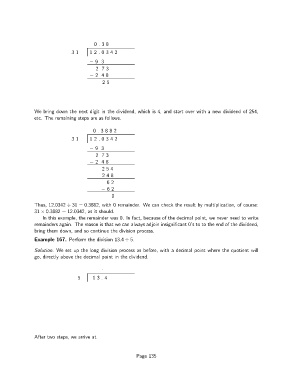
0. 3 8
                               31      12. 0342

                                      − 93
                                         27 3
                                      − 24 8
                                            25


               We bring down the next digit in the dividend, which is 4, and start over with a new dividend of 254,
               etc. The remaining steps are as follows.


                                        0. 3882
                               31      12. 0342
                                      − 93
                                         27 3
                                      − 24 8
                                            25 4
                                         − 248
                                              62
                                           − 62
                                                0

               Thus, 12.0342 ÷ 31 = 0.3882, with 0 remainder. We can check the result by multiplication, of course:
               31 × 0.3882 = 12.0342, as it should.
                   In this example, the remainder was 0. In fact, because of the decimal point, we never need to write
               remainders again. The reason is that we can always adjoin insignificant 0’s to to the end of the dividend,
               bring them down, and so continue the division process.
               Example 167. Perform the division 13.4 ÷ 5.

               Solution. We set up the long division process as before, with a decimal point where the quotient will
               go, directly above the decimal point in the dividend.

                                           .

                                  5     13 . 4


               After two steps, we arrive at


                                                          Page 135

