


Page 125 - ArithBook5thEd ~ BCC
P. 125
One final remark about step 2 of the procedure. If the digit in the round-off place is 9, and we need
               to round up (to 10), we must carry the 1 to the left-neighboring place.
               Example 153. Round 6.597 to the nearest hundredth.

               Solution. The 9 in the round-off place has right-neighbor 7, which is greater than 5. So we increase 9
               to 10, and carry the 1 to the (left-neighboring) tenths place:

                                           6.597 ≈ 6.60  (to the nearest hundredth)

               Notice we preserved the insignificant 0, since it is in the round-off place.

               4.4.1   Exercises

               Round off each number twice: (a) to the nearest ten; (b) to the nearest hundredth.

                1. 304.0900

                2. 96.075
                3. 115.497

                4. 100.0055

                5. 7.009


               4.5     Adding and Subtracting Decimals

               One of the advantages of decimals over ordinary fractions is ease of computation. The four operations
               (addition, subtraction, multiplication and division) are done almost exactly as with whole numbers. The
               only question is where to put the decimal point.
                   Addition and subtraction are the easiest: we line up the numbers vertically, with the ones places
               aligned on top of eachother. This puts the decimal points in alignment as well. The decimal point in the
               sum is placed directly below the decimal points in the numbers being added. Carrying and borrowing
               are done as with whole numbers.

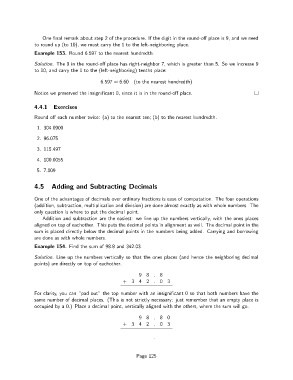
               Example 154. Find the sum of 98.8 and 342.03.
               Solution. Line up the numbers vertically so that the ones places (and hence the neighboring decimal
               points) are directly on top of eachother.

                                                           98. 8
                                                    +3 4 2 . 0 3

               For clarity, you can “pad out” the top number with an insignificant 0 so that both numbers have the
               same number of decimal places. (This is not strictly necessary: just remember that an empty place is
               occupied by a 0.) Place a decimal point, vertically aligned with the others, where the sum will go.

                                                           98. 80
                                                    +3 4 2 . 0 3

                                                                 .


                                                          Page 125

