


Page 144 - ArithBook5thEd ~ BCC
P. 144
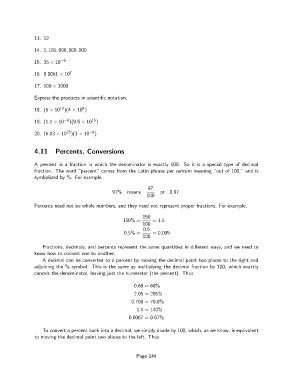
13. 12

               14. 1, 181, 000, 000, 000


               15. 35 × 10 −9

               16. 0.0061 × 10 7

               17. 100 × 1000

               Express the products in scientific notation.

                          13
                                   8
               18. (5 × 10 )(4 × 10 )
                                       15
               19. (1.1 × 10 −9 )(9.5 × 10 )
                             23
               20. (6.03 × 10 )(1 × 10 −9 )


               4.11     Percents, Conversions

               A percent is a fraction in which the denominator is exactly 100. So it is a special type of decimal
               fraction. The word “percent” comes from the Latin phrase per centum meaning “out of 100,” and is
               symbolized by %. For example,
                                                               97
                                                97%   means         or  0.97.
                                                              100

               Percents need not be whole numbers, and they need not represent proper fractions. For example,

                                                             150
                                                    150% =       =1.5
                                                             100
                                                             0.5
                                                     0.5% =      =0.005
                                                             100

                   Fractions, decimals, and percents represent the same quantities in different ways, and we need to
               know how to convert one to another.
                   A decimal can be converted to a percent by moving the decimal point two places to the right and
               adjoining the % symbol. This is the same as multiplying the decimal fraction by 100, which exactly
               cancels the denominator, leaving just the numerator (the percent). Thus

                                                         0.68 = 68%
                                                         2.05 = 205%
                                                        0.708 = 70.8%
                                                          1.4 = 140%
                                                       0.0067 = 0.67%


                   To convert a percent back into a decimal, we simply divide by 100,which, as we know,is equivalent
               to moving the decimal point two places to the left. Thus


                                                          Page 144

