


Page 142 - ArithBook5thEd ~ BCC
P. 142
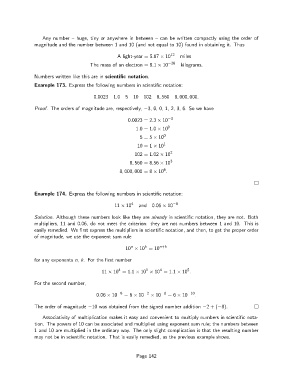
Any number – huge, tiny or anywhere in between – can be written compactly using the order of
               magnitude and the number between 1 and 10 (and not equal to 10) found in obtaining it. Thus

                                                  Alight-year = 5.87 × 10 12  miles
                                       The mass of an electron = 9.1 × 10 −28  kilograms.

               Numbers written like this are in scientific notation.

               Example 173. Express the following numbers in scientific notation:

                                        0.0023  1.0  5 10    102  8, 560  8, 000, 000.

               Proof. The orders of magnitude are, respectively, −3, 0, 0, 1, 2, 3, 6. So we have

                                                       0.0023 = 2.3 × 10 −3
                                                          1.0 = 1.0 × 10 0
                                                           5= 5 × 10 0
                                                          10 = 1 × 10 1

                                                         102 = 1.02 × 10 2
                                                       8, 560 = 8.56 × 10 3
                                                                     6
                                                   8, 000, 000 = 8 × 10 .


               Example 174. Express the following numbers in scientific notation:

                                                 11 × 10 4  and  0.06 × 10 −8

               Solution. Although these numbers look like they are already in scientific notation, they are not. Both
               multipliers, 11 and 0.06, do not meet the criterion: they are not numbers between 1 and 10. This is
               easily remedied. We first express the multipliers in scientific notation, and then, to get the proper order
               of magnitude, we use the exponent sum rule

                                                        n
                                                             k
                                                     10 × 10 =10    n+k
               for any exponents n, k. For the first number

                                                                    4
                                                                               5
                                                   4
                                                              1
                                            11 × 10 =1.1 × 10 × 10 =1.1 × 10 .
               For the second number,
                                         0.06 × 10 −8  =6 × 10 −2  × 10 −8  =6 × 10 −10 .

               The order of magnitude −10 was obtained from the signed number addition −2+ (−8).

                   Associativity of multiplication makes it easy and convenient to multiply numbers in scientific nota-
               tion. The powers of 10 can be associated and multiplied using exponent sum rule; the numbers between
               1 and 10 are multiplied in the ordinary way. The only slight complication is that the resulting number
               may not be in scientific notation. That is easily remedied, as the previous example shows.


                                                          Page 142

