


Page 140 - ArithBook5thEd ~ BCC
P. 140
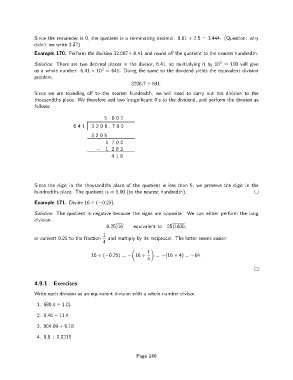
Since the remainder is 0, the quotient is a terminating decimal.8.61 ÷ 2.5 = 3.444. (Question: why
               didn’t we write 3.4?)
               Example 170. Perform the division 32.067÷6.41 and round off the quotient to the nearest hundredth.

                                                                                             2
               Solution. There are two decimal places in the divisor, 6.41, so multiplyingit by 10 =100 will give
                                           2
               us a whole number: 6.41 × 10 =641. Doing the same to the dividend yields the equivalent division
               problem,
                                                        3206.7 ÷ 641.

               Since we are rounding off to the nearest hundredth, we will need to carry out the division to the
               thousandths place. We therefore add two insignificant 0’s to the dividend, and perform the division as
               follows:

                                             5. 002
                                64 1   3206 . 70 0

                                   − 3205
                                             17 0 0
                                         − 12 8 2
                                                41 8


               Since the digit in the thousandths place of the quotient is less than 5, we preserve the digit in the
               hundredths place. The quotient is ≈ 5.00 (to the nearest hundredth).

               Example 171. Divide 16 ÷ (−0.25).

               Solution. The quotient is negative because the signs are opposite. We can either perform the long
               division
                                              0.25)16    equivalent to 25)1600,

                                            1
               or convert 0.25 to the fraction  and multiply by its reciprocal. The latter seems easier:
                                            4
                                                        "       #
                                                               1
                                       16 ÷ (−0.25) = − 16 ÷      = −(16 × 4) = −64.
                                                               4


               4.9.1   Exercises

               Write each division as an equivalent division with a whole number divisor.

                1. 680.4 ÷ 1.01

                2. 0.48 ÷ 11.4
                3. 804.09 ÷ 9.18

                4. 9.8 ÷ 0.0215


                                                          Page 140

