


Page 181 - ArithBook5thEd ~ BCC
P. 181
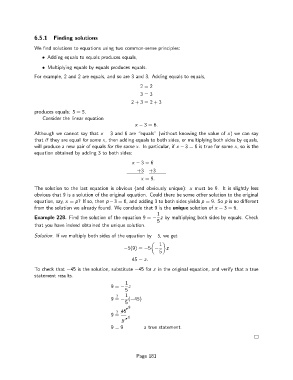
6.5.1   Finding solutions

               We find solutions to equations using two common-sense principles:
                   • Adding equals to equals produces equals,

                   • Multiplying equals by equals produces equals.
               For example, 2 and 2 are equals, and so are 3 and 3. Adding equals toequals,

                                                            2= 2
                                                            3= 3
                                                        2+ 3 = 2 + 3
               produces equals: 5 = 5.
                   Consider the linear equation
                                                         x − 3= 6.
               Although we cannot say that x − 3 and 6 are “equals” (without knowing the value of x)we can say
               that if they are equal for some x,then adding equals to both sides, or multiplying both sides by equals,
               will produce a new pair of equals for the same x. In particular, if x − 3 = 6 is true for some x,so is the
               equation obtained by adding 3 to both sides:

                                                        x − 3= 6
                                                          +3 +3
                                                            x =9.
               The solution to the last equation is obvious (and obviously unique): x must be 9. It is slightly less
               obvious that 9 is a solution of the original equation. Could there be some other solution to the original
               equation, say, x = p?If so, then p −3= 6, and adding 3toboth sides yields p =9. So p is no different
               from the solution we already found. We conclude that 9 is the unique solution of x − 3= 6.
                                                                   1
               Example 228. Find the solution of the equation 9 = − z by multiplying both sides by equals. Check
                                                                   5
               that you have indeed obtained the unique solution.

               Solution. If we multiply both sides of the equation by −5, we get
                                                                "    #
                                                                    1
                                                     −5(9) = −5 −      z
                                                                    5
                                                      −45 = z.

               To check that −45 is the solution, substitute −45 for z in the original equation, and verify that a true
               statement results.
                                                     1
                                               9= − z
                                                     5
                                                  ?  1
                                               9 = − (−45)
                                                     5
                                                     ✚❃
                                                  ? ✚ 45  9
                                               9 =    1
                                                    ✚ 5 ✚❃
                                               9 = 9         a true statement.


                                                          Page 181

