


Page 184 - ArithBook5thEd ~ BCC
P. 184
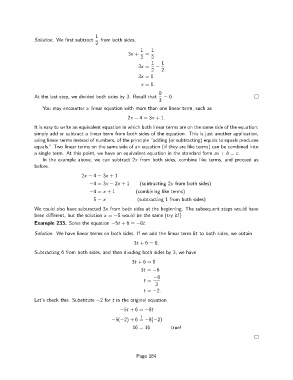
1
               Solution. We first subtract  from both sides.
                                         2
                                                            1   1
                                                       3x +   =
                                                            2   2
                                                                1   1
                                                           3x =   −
                                                                2   2
                                                           3x =0
                                                            x =0.

                                                                   0
               At the last step, we divided both sides by 3. Recall that  =0.
                                                                   3
                   You may encounter a linear equation with more than one linear term, such as
                                                      2x − 4= 3x +1.
               It is easy to write an equivalent equation in which both linear terms are on the same side of the equation:
               simply add or subtract a linear term from both sides of the equation. This is just another application,
               using linear terms instead of numbers, of the principle “adding (or subtracting) equals to equals produces
               equals.” Two linear terms on the same side of an equation (if they are like terms) can be combined into
               a single term. At this point, we have an equivalent equation in the standard form ax + b = c.
                   In the example above, we can subtract 2x from both sides, combine like terms, and proceed as
               before.
                                   2x − 4= 3x +1
                                      −4= 3x − 2x + 1      (subtracting 2x from both sides)
                                      −4= x + 1           (combining like terms)
                                      −5= x               (subtracting 1 from both sides)

               We could also have subtracted 3x from both sides at the beginning. The subsequent steps would have
               been different, but the solution x = −5 would be the same (try it!)
               Example 233. Solve the equation −5t +6 = −8t.
               Solution. We have linear terms on both sides. If we add the linear term 8t to both sides, we obtain

                                                         3t +6 = 0.
               Subtracting 6 from both sides, and then dividing both sides by 3,we have

                                                        3t +6 = 0
                                                            3t = −6
                                                                 −6
                                                             t =
                                                                  3
                                                             t = −2.

               Let’s check this. Substitute −2for t in the original equation.
                                                   −5t +6 = −8t
                                                            ?
                                                −5(−2) + 6 = −8(−2)
                                                        16 = 16         true!


                                                          Page 184

