


Page 182 - ArithBook5thEd ~ BCC
P. 182
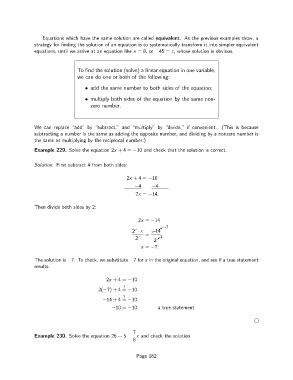
Equations which have the same solution are called equivalent. As the previous examples show, a
               strategy for finding the solution of an equation is to systematically transform it into simpler equivalent
               equations, until we arrive at an equation like x =8, or −45 = z,whose solution is obvious.


                                 To find the solution (solve) a linear equation in one variable,
                                 we can do one or both of the following:

                                     • add the same number to both sides of the equation;

                                     • multiply both sides of the equation by the same non-
                                       zero number.


               We can replace “add” by “subtract,” and “multiply” by “divide,”if convenient. (This is because
               subtracting a number is the same as adding the opposite number, and dividing by a nonzero number is
               the same as multiplying by the reciprocal number.)
               Example 229. Solve the equation 2x +4 = −10 and check that the solution is correct.


               Solution. First subtract 4 from both sides:


                                                      2x +4 = −10
                                                         −4     −4
                                                          2x = −14.

               Then divide both sides by 2:


                                                           2x = −14
                                                                   ✟✯
                                                                −14
                                                        ✚ ✚ 2 · x  ✟ ✟  −7
                                                              =
                                                         ✚ ✚ 2    ✚❃ 1
                                                                 ✚ 2
                                                            x = −7.
               The solution is −7. To check, we substitute −7for x in the original equation, and see if a true statement
               results.

                                             2x +4 = −10
                                                     ?
                                          2(−7) + 4 = −10
                                                     ?
                                            −14 + 4 = −10
                                                −10 = −10          a true statement


                                                         7
               Example 230. Solve the equation 26 = 5 − x and check the solution.
                                                         8


                                                          Page 182

