


Page 62 - ArithBook5thEd ~ BCC
P. 62
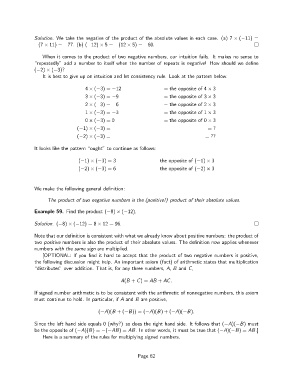
Solution. We take the negative of the product of the absolute values in each case. (a) 7 × (−11) =
               −(7 × 11) = −77. (b) (−12) × 5= −(12 × 5) = −60.

                   When it comes to the product of two negative numbers, our intuition fails. It makes no sense to
               “repeatedly” add a number to itself when the number of repeats is negative!How should we define
               (−2) × (−3)?
                   It is best to give up on intuition and let consistency rule. Look at the pattern below:

                                     4 × (−3) = −12                   = the opposite of 4 × 3
                                     3 × (−3) = −9                    = the opposite of 3 × 3

                                     2 × (−3) = −6                    = the opposite of 2 × 3
                                     1 × (−3) = −3                    = the opposite of 1 × 3
                                     0 × (−3) = 0                     = the opposite of 0 × 3
                                 (−1) × (−3) =                                          =?
                                 (−2) × (−3) =                                         =??

               It looks like the pattern “ought” to continue as follows:

                                  (−1) × (−3) = 3                   the opposite of (−1) × 3
                                  (−2) × (−3) = 6                   the opposite of (−2) × 3


               We make the following general definition:

                     The product of two negative numbers is the (positive!) product of their absolute values.
               Example 59. Find the product (−8) × (−12).


               Solution. (−8) × (−12) = 8 × 12 = 96.

               Note that our definition is consistent with what we already know about positive numbers: the product of
               two positive numbers is also the product of their absolute values. The definition now applies whenever
               numbers with the same sign are multiplied.
                   [OPTIONAL: If you find it hard to accept that the product of two negative numbers is positive,
               the following discussion might help. An important axiom (fact) of arithmetic states that multiplication
               “distributes” over addition. That is, for any three numbers, A, B and C,

                                                   A(B + C)= AB + AC.


               If signed number arithmetic is to be consistent with the arithmetic of nonnegative numbers, this axiom
               must continue to hold. In particular, if A and B are positive,

                                          (−A)(B +(−B)) = (−A)(B)+ (−A)(−B).


               Since the left hand side equals 0 (why?) so does the right hand side. It follows that (−A)(−B)must
               be the opposite of (−A)(B)= −(−AB)= AB. In other words, it must be true that (−A)(−B)= AB.]
                   Here is a summary of the rules for multiplying signed numbers.


                                                           Page 62

