


Page 57 - ArithBook5thEd ~ BCC
P. 57
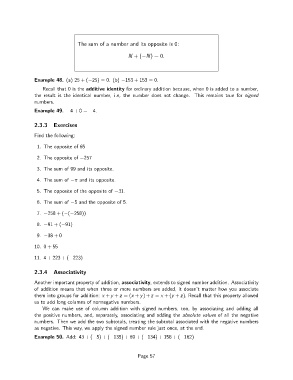
The sum of a number and its opposite is 0:

                                                       N +(−N)= 0.


               Example 48. (a) 25 + (−25) = 0. (b) −153 + 153 = 0.
                   Recall that 0 is the additive identity for ordinary addition because, when 0 is added to a number,
               the result is the identical number, i.e, the number does not change. This remains true for signed
               numbers.
               Example 49. −4+ 0 = −4.


               2.3.3   Exercises

               Find the following:

                1. The opposite of 65
                2. The opposite of −257

                3. The sum of 99 and its opposite.

                4. The sum of −π and its opposite.

                5. The opposite of the opposite of −31.

                6. The sum of −5and the opposite of 5.

                7. −258 + (−(−258))

                8. −91 + (−91)

                9. −38 + 0

               10. 0 + 55
               11. 4 + 223 + (−223)


               2.3.4   Associativity

               Another important property of addition, associativity,extends to signed number addition. Associativity
               of addition means that when three or more numbers are added, it doesn’t matter how you associate
               them into groups for addition: x + y + z =(x + y)+ z = x +(y + z). Recall that this property allowed
               us to add long columns of nonnegative numbers.
                   We can make use of column addition with signed numbers, too, by associating and adding all
               the positive numbers, and, separately, associating and addingthe absolute values of all the negative
               numbers. Then we add the two subtotals, treating the subtotal associated with the negative numbers
               as negative. This way, we apply the signed number rule just once, at the end.
               Example 50. Add: 43 + (−5) + (−135) + 69 + (−134) + 158 + (−162)


                                                           Page 57

