


Page 59 - ArithBook5thEd ~ BCC
P. 59
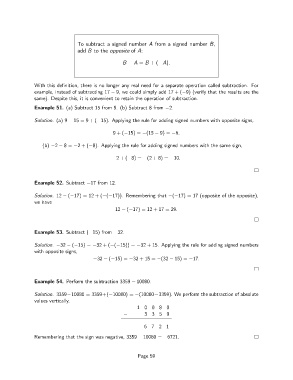
To subtract a signed number A from a signed number B,
                                 add B to the opposite of A:


                                                    B − A = B +(−A).


               With this definition, there is no longer any real need for a separate operation called subtraction. For
               example, instead of subtracting 17 − 9, we could simply add 17 + (−9) (verify that the results are the
               same). Despite this, it is convenient to retain the operation of subtraction.

               Example 51. (a) Subtract 15 from 9. (b) Subtract 8 from −2.

               Solution. (a) 9 − 15 = 9 + (−15). Applying the rule for adding signed numbers with opposite signs,

                                                9+ (−15) = −(15 − 9) = −6.

                   (b) −2 − 8= −2+ (−8). Applying the rule for adding signed numbers with the same sign,

                                                −2+ (−8) = −(2 + 8) = −10.


               Example 52. Subtract −17 from 12.

               Solution. 12 − (−17) = 12 + (−(−17)). Remembering that −(−17) = 17 (opposite of the opposite),
               we have
                                                 12 − (−17) = 12 + 17 = 29.


               Example 53. Subtract (−15) from −32.

               Solution. −32 − (−15) = −32 + (−(−15)) = −32 + 15. Applying the rule for adding signed numbers
               with opposite signs,
                                        −32 − (−15) = −32 + 15 = −(32 − 15) = −17.


               Example 54. Perform the subtraction 3359 − 10080.

               Solution. 3359−10080 = 3359+(−10080) = −(10080−3359). We perform the subtraction of absolute
               values vertically.
                                                          10 08 0
                                                     −       33 59
                                                             67 21

               Remembering that the sign was negative, 3359 − 10080 = −6721.


                                                           Page 59

